
Your business likely falls into one of two scenarios. Either you have existing web or mobile software that needs AI capabilities, or you are building a new product with AI at its core. In both cases, the challenge is the same: connecting AI models to real business logic without creating a fragile, expensive system.
Pegotec handles both scenarios. We have been building production software with Laravel, Flutter, and JavaScript for nine years. AI software integration is a natural extension of that work — not a separate discipline. Our engineers add intelligent features to existing applications and build new AI-native products using the same frameworks, development standards, and focus on maintainability that define all our projects. For a broader view of our capabilities, visit our AI solutions overview.
AI Integration Services
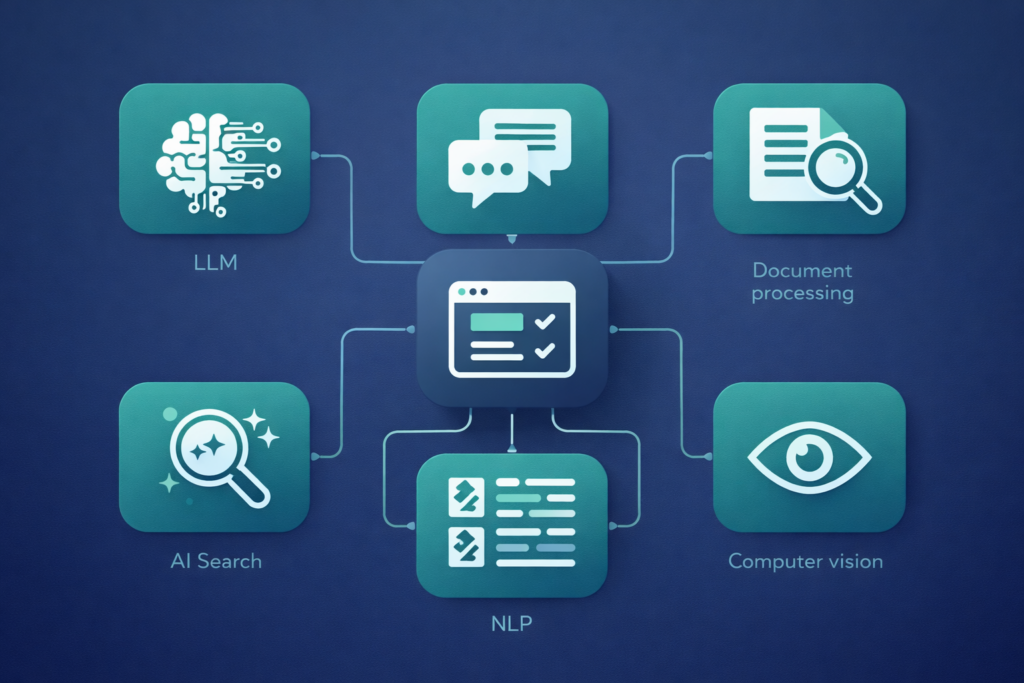
We deliver six categories of AI software integration. Each one connects directly to measurable business outcomes — faster processing, lower costs, or better user experiences.
LLM Integration
We connect your applications to large language models from Anthropic (Claude), OpenAI (GPT), Google (Gemini), and open-source providers. This includes API layer design, prompt engineering, response parsing, and error handling. Every integration includes fallback logic, so your application stays functional even when a provider experiences downtime.
Chatbot and Conversational AI
We build chatbots that go beyond scripted responses. Our conversational AI solutions use LLMs to understand context, reference your business data, and handle multi-turn conversations. As a result, your customers get accurate answers without waiting for human support. We design conversation flows, build knowledge bases, and implement escalation paths to human agents when needed.
Document Processing and Analysis
AI can extract, classify, and summarize information from PDFs, invoices, contracts, and reports. We build document processing pipelines that turn unstructured files into structured data your application can use. This eliminates hours of manual data entry and reduces human error in critical workflows.
AI-Powered Search and Recommendations
Traditional keyword search misses context. We integrate semantic search using vector embeddings, so users find results based on meaning rather than exact word matches. Similarly, our recommendation engines analyze user behavior and content relationships to surface relevant products, articles, or actions. Both features improve engagement and conversion rates.
Natural Language Processing Features
NLP capabilities include sentiment analysis, text classification, entity extraction, and language translation. We integrate these features into your existing interfaces — for example, automatically categorizing support tickets or detecting tone in customer feedback. These additions make your software smarter without changing how users interact with it.
Computer Vision Integration
We add image and video analysis capabilities to mobile and web applications. Use cases include product recognition, quality inspection, receipt scanning, and identity verification. Our team selects the right vision model to meet your accuracy and speed requirements, then integrates it into your application’s existing data flow.
Technology Stack
We build AI features on the same frameworks we use for all our projects. This means your AI integration is not a separate system — it lives inside your existing codebase.
Laravel and AI
Laravel is our primary backend framework for integrating AI software. It handles API routing, queue management for long-running AI tasks, caching to reduce redundant API calls, and built-in cost controls through rate limiting and usage tracking. We have published a detailed guide on Laravel LLM integration that covers our architecture patterns. Laravel’s job queue system is particularly valuable because AI API calls often take several seconds — queuing them prevents your application from blocking user requests.
Flutter and AI
Flutter powers our cross-platform mobile applications. We integrate on-device AI features where latency matters — such as real-time text suggestions or image classification. For heavier processing, Flutter communicates with our Laravel backend’s AI services. This hybrid approach balances speed with capability while keeping mobile apps responsive.
JavaScript and AI
JavaScript frameworks handle real-time AI interactions on the client side. This includes streaming LLM responses, interactive chat interfaces, and client-side preprocessing before sending data to the server. Consequently, users see results immediately rather than waiting for a full server round-trip.
n8n and AI Workflows
For workflow automation, we use n8n as our visual orchestration platform. It connects AI models to business tools — CRMs, email systems, databases, and external APIs — without custom code for every connection. Our guide on n8n AI workflows explains how we design multi-agent systems using this approach.
Multi-Provider API Architecture
We design API layers that support multiple AI providers simultaneously. Your application can use Claude for complex reasoning, GPT for creative content, and Gemini for multimodal tasks — all through a single internal API. Moreover, automatic fallbacks ensure continuity if any provider goes down. This architecture also makes it easy to adopt new models as they become available.
How We Control AI Costs
AI API costs can spiral quickly without deliberate architecture decisions. We build cost control into every AI software integration project from day one. Our published guide on reducing AI costs details the full methodology. Here are the key strategies we apply.
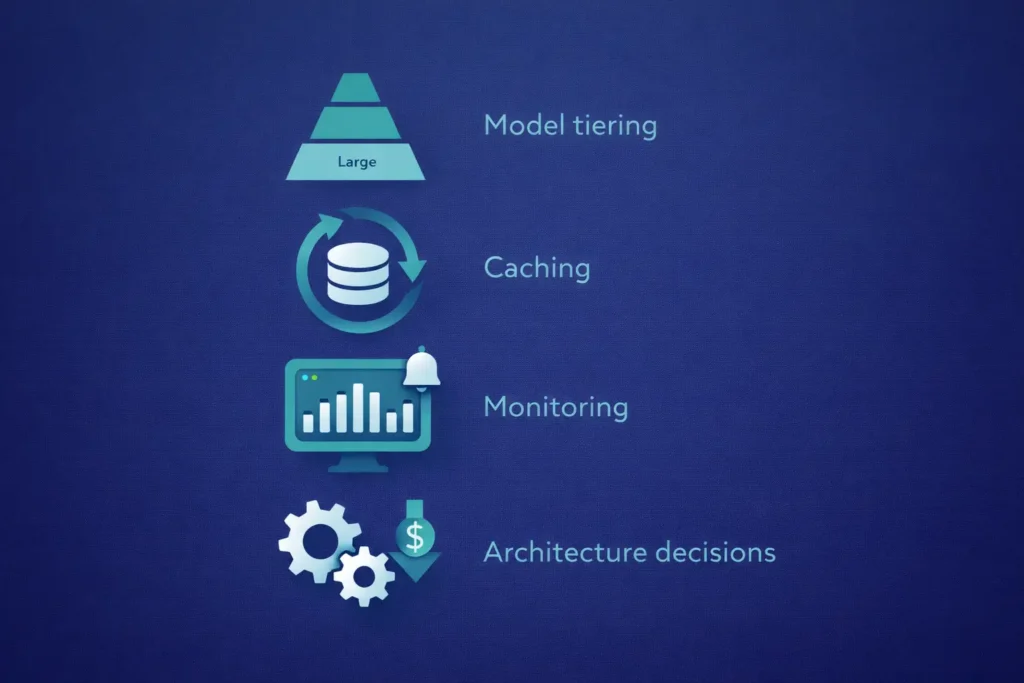
Model tiering is the most effective technique. Not every task needs the most powerful model. We route simple classification tasks to smaller, cheaper models and reserve advanced models for complex reasoning. This single decision often reduces costs by 30% to 50%.
Caching and prompt optimization prevent redundant API calls. If your application repeatedly asks the same type of question, we cache responses and reuse them. Additionally, we refine prompts to use fewer tokens while maintaining output quality.
Usage monitoring and alerting give you visibility into spending. We implement dashboards that track cost per feature, cost per user, and cost trends over time. Automated alerts notify your team before budgets are exceeded.
Architecture decisions compound these savings. Batch processing instead of real-time calls, preprocessing inputs to reduce token counts, and strategic use of embeddings versus full LLM calls — these choices typically reduce AI operating costs by 40% to 70% compared to naive implementations.
Our Integration Approach
Every AI software integration project follows a structured four-phase approach. This process reduces risk and ensures each phase delivers value before moving to the next.
Phase 1: Architecture assessment. We review your existing codebase, data flows, and infrastructure. This identifies where AI fits naturally and where changes are needed. The assessment also surfaces constraints — data privacy requirements, performance expectations, and budget boundaries.
Phase 2: API layer design. We design the integration layer that connects your application to AI services. This includes provider selection, fallback logic, authentication, rate limiting, and cost controls. You approve the architecture before development begins.
Phase 3: Phased rollout. We implement AI features in stages, starting with the highest-impact use case. Each phase goes through testing, staging, and production deployment. Consequently, your team can evaluate real results before committing to the next phase.
Phase 4: Monitoring and iteration. After launch, we track performance, accuracy, cost, and user adoption. Based on real data, we optimize prompts, adjust model selection, and refine the user experience. Our AI maintenance service covers ongoing optimization for production AI features.
Frequently Asked Questions
Yes. Laravel is our primary backend framework, and we have extensive experience adding AI features to existing Laravel codebases. We design an API layer that integrates with your current architecture — controllers, services, queues, and database — without requiring a rewrite. Most Laravel AI integrations begin producing results within four to six weeks.
We work with Anthropic (Claude), OpenAI (GPT), Google (Gemini), Meta (Llama), Mistral, and other open-source models. For most business applications, we recommend Claude for its reliability and reasoning quality. However, we design multi-provider architectures so you are never locked into a single vendor. The right choice depends on your use case, budget, and data privacy requirements.
We apply four strategies: model tiering (using smaller models for simpler tasks), caching and prompt optimization (reducing redundant API calls), usage monitoring with automated alerts, and architecture decisions that minimize token consumption. Together, these typically reduce AI operating costs by 40% to 70% compared to basic implementations. We publish our full methodology in our guide on reducing AI costs.
A focused AI integration — such as adding a chatbot or document processing feature — typically takes four to eight weeks from assessment to production. Larger projects with multiple AI features may span three to four months and be delivered in phased rollouts. The timeline depends on your existing architecture, the complexity of the AI features, and your data readiness. We provide a realistic estimate after the initial architecture assessment.
Start Your AI Integration Project
Whether you need to add a single AI feature to an existing application or build a new AI-native product, we can help. Our team combines nine years of software engineering experience with practical AI expertise. Tell us about your project, and we will provide an honest assessment of what AI can — and cannot — do for your specific situation.
Contact Pegotec to schedule an initial consultation —no commitment required—just a clear conversation about your goals and options.