
For years, chatbots meant decision trees. A visitor clicked a button, followed a script, and hoped the pre-written answers matched their question. Those days are over. Modern AI chatbots understand natural language, remember context across a conversation, and learn from your actual business data. As a result, they handle complex queries that scripted bots could never manage.
However, many businesses have been burned by chatbot projects that overpromised and underdelivered. The chatbot gave wrong answers, frustrated customers, or cost more than it saved. That happens when the technology is treated as a gimmick rather than a business tool.
Pegotec takes a different approach to AI chatbot development. We build chatbots that solve specific, measurable problems — reducing support ticket volume, qualifying leads, or making internal knowledge searchable. Every chatbot we deliver includes guardrails, cost controls, and a clear path to human escalation. For a broader view of our capabilities, visit our AI solutions overview.
What We Build
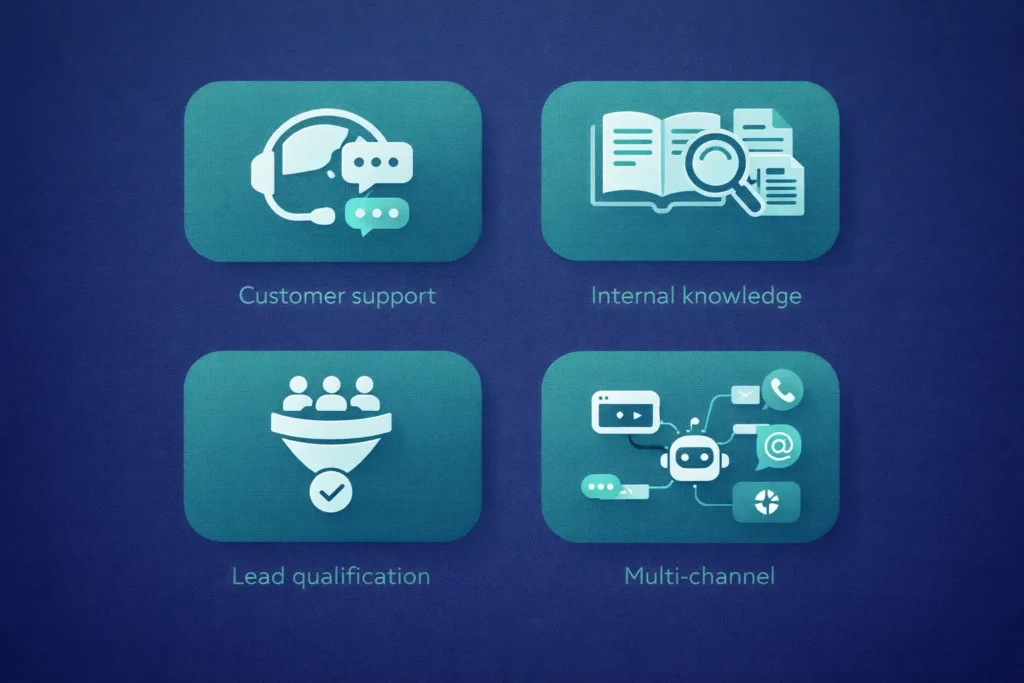
We deliver four types of AI chatbots. Each one targets a specific business function and produces measurable results.
Customer Support Chatbots
Support teams spend most of their time answering the same questions repeatedly. Order status, return policies, password resets, and billing inquiries make up the bulk of inbound tickets. Our customer support chatbots handle these common queries around the clock. They pull answers directly from your knowledge base, so responses stay accurate and consistent.
When a question falls outside the chatbot’s scope, it is seamlessly escalated to a human agent. The agent receives the full conversation history, so the customer never has to repeat themselves. Businesses that deploy these chatbots typically see a 40% to 60% reduction in support ticket volume. That frees your team to focus on complex issues that genuinely need human judgment.
Internal Knowledge Bots
Most companies have useful documentation buried in shared drives, wikis, and scattered folders. Employees waste time searching for policies, procedures, and technical specifications. An internal knowledge bot changes that entirely. Your team asks a question in plain language, and the bot searches your documents to deliver a precise answer.
This works especially well for onboarding new employees, navigating HR policies, and finding technical documentation. Instead of asking a colleague or digging through folders, employees get instant answers grounded in your actual company data.
Lead Qualification Bots
Website visitors often leave without taking action because nobody engages them at the right moment. A lead qualification bot starts a conversation proactively. It asks relevant questions, identifies the visitor’s needs, and determines whether they match your ideal customer profile. Qualified prospects are routed directly to your sales team with a summary of the conversation.
Unlike static forms, these bots adapt their questions based on responses. They feel like a natural conversation, not an interrogation. Consequently, more visitors engage, and your sales team receives higher-quality leads.
Multi-Channel Deployment
Your customers communicate through different channels. Some prefer your website, others use WhatsApp, and internal teams may rely on Slack or Microsoft Teams. We build a single chatbot logic layer that deploys across all these channels simultaneously. The conversation quality remains identical regardless of the platform.
Adding a new channel later does not require rebuilding the chatbot. Because the core logic is separate from the delivery layer, we connect a new channel adapter. This architecture keeps costs low as your needs grow.
How Our Chatbots Work
Our chatbots are built on large language models like Claude and GPT. But a raw LLM on its own is not enough for business use. It can hallucinate, go off topic, or provide outdated information. That is why we use Retrieval-Augmented Generation, commonly known as RAG.
RAG works straightforwardly. Before the chatbot generates a response, it first searches your actual documents, databases, or knowledge base for relevant information. Then it constructs its answer based on those retrieved facts. As a result, the chatbot’s responses are grounded in your real data — not invented from the model’s general training.
We also implement strict guardrails. These define what the chatbot can and cannot discuss. For example, a customer support bot should answer product questions but should never give legal or medical advice. Guardrails prevent the chatbot from straying into topics that could create liability or confusion for your business.
Conversation memory is another critical feature. Our chatbots maintain context across multiple exchanges within a session. If a customer mentions their order number at the start, the bot remembers it throughout the conversation. This eliminates the frustrating experience of having to repeat information with every message.
Finally, every chatbot includes a human handoff mechanism. When the bot detects uncertainty — a question outside its knowledge, a frustrated user, or a request that requires human authority — it transfers the conversation to a live agent. The handoff includes full context, so the transition feels seamless. For details on connecting chatbots to your broader tech stack, see our AI integration services.
Cost and ROI
A well-built AI chatbot typically pays for itself within three to six months. The math is straightforward. If your support team handles 1,000 tickets per month and the chatbot resolves 50% of them, that is 500 fewer tickets requiring human time. Multiply those saved hours by your average agent cost, and the savings become clear quickly.
We design every chatbot for cost efficiency from the start. Prompt caching stores common responses so the system avoids redundant API calls. Model tiering routes simple queries to smaller, cheaper models while reserving advanced models for complex questions. These techniques keep ongoing AI API costs predictable and transparent.
You always know what your chatbot costs to operate. We build usage dashboards that track cost per conversation, cost per resolution, and monthly spending trends. There are no hidden fees or surprise invoices. Our published AI chatbot ROI framework explains the full calculation methodology. Additionally, our guide on reducing AI costs covers the optimization techniques we apply to every project.
Our Technology Stack
We build chatbots using the same production-grade tools we use across all Pegotec projects. This ensures maintainability, performance, and long-term support.
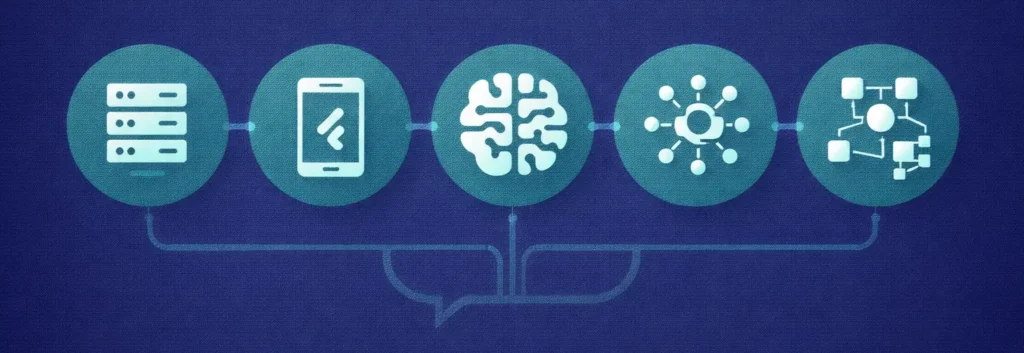
Laravel serves as the backend foundation. It handles API management, queue processing for AI requests, response caching, and usage-based cost controls. Laravel’s job queue system is essential because LLM calls often take several seconds — queuing prevents the chatbot from blocking other application processes.
Flutter powers mobile chatbot interfaces when clients need a native app experience. It delivers smooth, responsive chat UIs on both iOS and Android from a single codebase.
Claude by Anthropic is our primary LLM. It excels at following instructions precisely, staying within defined boundaries, and producing safe, reliable outputs. These qualities make it particularly well-suited for business chatbots where accuracy and safety matter most.
A multi-provider architecture means you are never locked into a single LLM vendor. If a better model launches or pricing changes, we can switch providers without rebuilding your chatbot. This flexibility protects your investment over time.
n8n connects the chatbot to your existing business tools. Whether you need conversations logged in your CRM, tickets created in your helpdesk, or follow-up emails sent automatically, n8n handles these connections through visual workflow automation. No custom integration code is needed for standard business tools.
Frequently Asked Questions
The cost depends on the chatbot’s scope, channels, and data complexity. A focused customer support chatbot typically starts in the low five-figure range for development. Ongoing AI API costs typically range from $100 to $500 per month for small- to mid-sized businesses, depending on conversation volume. We provide a detailed estimate after an initial consultation.
No, and that is not the goal. AI chatbots excel at handling repetitive, well-defined queries — password resets, order status checks, policy questions, and similar tasks. Complex issues, emotional situations, and edge cases still need human agents. The chatbot reduces your team’s workload by 40% to 60%, so your agents can focus on the interactions that truly require human empathy and judgment.
We use three layers of protection. First, Retrieval-Augmented Generation (RAG) ensures the chatbot answers based on your actual documents and data, not general knowledge. Second, guardrails restrict the chatbot to approved topics and prevent off-topic responses. Third, confidence detection triggers a handoff to a human agent when the bot is uncertain about an answer. Together, these measures keep accuracy high and risk low.
A single-channel chatbot with a well-defined scope typically takes six to ten weeks from kickoff to production. Multi-channel deployments or chatbots that require complex data integrations may take ten to fourteen weeks. We deliver in phases, so you see working results early in the project rather than waiting until the end. The exact timeline depends on your data readiness and the number of use cases.
Ready to Add an AI Chatbot to Your Business?
Whether you need a customer support bot, an internal knowledge assistant, or a lead qualification tool, we can help. Our team combines nine years of software engineering experience with practical AI expertise. Tell us about your use case, and we will give you an honest assessment of what a chatbot can realistically achieve for your situation.
Contact Pegotec to schedule an initial consultation —no commitment required—just a clear conversation about your goals, timeline, and budget.