
AI agents are the next evolution beyond chatbots. A chatbot answers questions. An agent completes tasks — autonomously, across multiple systems, without waiting for human input at every step. As a result, businesses can automate complex processes that were previously impossible to hand off to software.
The market interest is enormous. According to Gartner, 40% of enterprise applications will include task-specific AI agents by late 2026, up from less than 5% in 2025. McKinsey estimates that AI agents could add $2.6 to $4.4 trillion in annual value globally. However, Gartner also warns that more than 40% of agentic AI projects will be canceled by 2027 due to unclear value or cost overruns. In practice, only 1 in 9 enterprises currently runs agents in production.
At Pegotec, we build AI agents that work in production — not just in demos. The difference comes down to approach. We start with a clear business problem, define measurable success criteria, and build with cost controls from day one. Technology is the enabler, not the starting point. If you need AI solutions that deliver real results, agents may be the right fit — but only when applied to the right problems.
What AI Agents Do
An AI agent is software that receives a goal, breaks it into steps, executes those steps using tools, and adapts when something goes wrong. Unlike a simple script, an agent makes decisions at each stage. It determines what information it needs, which tools to use, and when to escalate to a human. This makes agents fundamentally different from both chatbots and traditional automation.
A chatbot responds to questions within a conversation. It waits for input, generates a reply, and stops. In contrast, an agent takes action across multiple systems without waiting for instructions at every step. For example, an AI chatbot can answer a customer’s question about account status. An agent can verify the account, identify a billing issue, apply a credit, send a confirmation email, and update the CRM — all from a single request.
Traditional automation follows fixed rules. If condition A is true, then act B. These rule-based systems break when they encounter edge cases or ambiguous inputs. AI agents, on the other hand, evaluate context and make judgment calls. They handle variability that would require dozens of if-then rules to cover manually.
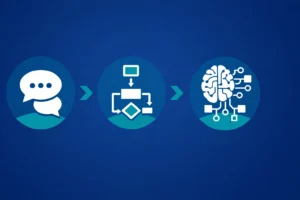
Here is a simple analogy. A chatbot is a receptionist who answers your questions. Traditional automation is a vending machine that follows a fixed sequence. An agent is an employee who understands your goal and figures out how to get it done — even when the path is not straightforward. For a deeper look at how agents are changing business operations, see our guide on AI agents for business automation.
Business Use Cases
Customer Onboarding Agents
Customer onboarding involves multiple steps that span several systems. An onboarding agent collects required documents, verifies submitted information against databases, sets up accounts in your CRM and billing systems, and sends personalized welcome sequences. When documents are missing or information does not match, the agent automatically follows up. As a result, onboarding that previously took days of manual coordination can happen in hours.
Research and Data Agents
Research agents gather information from multiple sources, evaluate relevance, and compile structured reports. They can monitor competitor pricing, aggregate industry news, summarize regulatory updates, or pull data from APIs and websites. Instead of an analyst spending hours on manual research, an agent delivers a draft report for human review and refinement. This approach works well for recurring research tasks with consistent output formats.
Document Processing Agents
Document processing agents go beyond simple data extraction. They read invoices, contracts, and forms regardless of format. Then they extract key data points, cross-reference them against existing records, route documents to the correct department, and flag anomalies for human review. Because they understand context rather than matching templates, they handle format variations that would break rule-based systems.
Internal Operations Agents
Operations agents handle routine internal tasks that consume staff time daily. They monitor system health and proactively alert teams. Agents generate weekly performance reports from multiple data sources. They triage incoming support tickets by urgency and topic. They update records across tools when changes occur in one system. Each of these tasks is small on its own, but together they free up significant capacity for higher-value work.
Multi-Agent Workflows
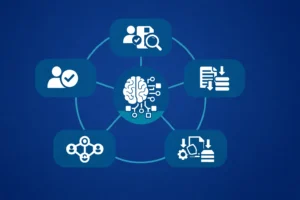
For complex processes, multiple specialized agents can work together. One agent researches, another analyzes, a third drafts a recommendation, and a coordinator agent manages the overall workflow. We orchestrate these multi-agent systems using n8n or custom Laravel middleware, depending on the complexity. To learn more about this approach, read our article on n8n AI agent-to-agent workflows. Similarly, our piece on AI agents replacing traditional SaaS explores how agent workflows are changing business tool architectures.
Why Most AI Agent Projects Fail
Despite the hype, most AI agent projects never reach production. Understanding why helps avoid the same mistakes. The most common failure pattern is starting too ambitiously. Companies try to automate entire departments instead of specific, well-defined tasks. Consequently, projects grow in scope, timelines stretch, and stakeholders lose confidence before seeing results.
Another frequent issue is the absence of clear success metrics. Without measurable goals defined upfront, teams cannot demonstrate value — even when the agent works correctly. Additionally, many organizations underestimate ongoing costs. Agents make multiple LLM calls per task, and those API costs compound quickly at scale. A guide to reducing AI costs is essential reading before any agent project begins.
Perhaps the most dangerous oversight is building agents without human oversight. Agents need guardrails, confidence thresholds, and clear escalation paths. Without these, a single bad decision can cascade through connected systems. At Pegotec, our approach is straightforward: start narrow, prove value on one specific task, then expand. We cover the fundamentals of planning in our AI project planning service, which we recommend as a first step for any agent initiative.
Our Agent Development Approach
We follow a structured process that prioritizes working software over impressive demos. First, we define the task and success criteria together. What specific outcome should the agent produce? How do we measure whether it succeeded? These questions must have clear answers before development begins.
Next, we build with cost controls from day one. This means implementing model tiering — using lightweight models for simple steps and reserving capable models for complex reasoning. We add response caching, prompt optimization, and per-task budget limits. As a result, you always know what your agents cost to operate.
For critical decisions, we build human-in-the-loop checkpoints. The agent handles routine work autonomously but pauses and requests approval when confidence is low or when the stakes are high. This balances efficiency with safety. After deployment, we monitor agent performance continuously and iterate based on real data — not assumptions.
Our technology stack includes Claude as the primary LLM for reasoning, n8n for workflow orchestration, and Laravel for business logic and API integration. For simpler processes that do not require full agent capabilities, we recommend our workflow automation service instead. Every agent we build also benefits from the cost-optimization strategies outlined in our business guide to reducing AI costs. Additionally, our AI maintenance service ensures your agents stay effective as models and business requirements evolve.
Frequently Asked Questions
A chatbot responds to questions within a conversation. It waits for input, generates a reply, and stops. An AI agent takes autonomous action to complete multi-step tasks. It can break down a goal, use tools across multiple systems, make decisions, and adapt when things go wrong — all without waiting for human input at every step. Chatbots are ideal for Q&A and customer support. Agents are better suited to complex workflows such as onboarding, research, and document processing.
Development costs vary based on complexity. A single-task agent with one integration typically starts in the low thousands. Multi-step agents that connect several systems cost more due to the integration work and testing requirements. Beyond development, ongoing costs include LLM API usage (agents make multiple calls per task), hosting, and monitoring. We provide detailed cost projections during the planning phase and build budget controls into every agent, so operational costs never surprise you.
Yes, when built correctly. The key factors are narrow scope, clear guardrails, human-in-the-loop checkpoints for critical decisions, and continuous monitoring. Agents that try to do too much or lack oversight are unreliable. Agents built for specific tasks with proper error handling and escalation paths perform consistently. We design every agent with confidence thresholds — when the agent is uncertain, it pauses and requests human review instead of guessing.
Absolutely. AI agents connect to your existing systems through APIs. Common integrations include CRM platforms, ERP systems, email services, cloud storage, databases, and project management tools. We use n8n for orchestration, which offers pre-built connectors to hundreds of business tools. For custom or legacy systems, we build API middleware in Laravel. The goal is always to enhance your current tools — not replace them.
Get Started with AI Agents
AI agents deliver real value — but only when applied to the right problems with the right approach. If you are considering agent development for your business, start with a conversation. Book a free consultation with our team. We will assess your use case, identify whether an agent is the right solution (or whether simpler automation would be more effective), and provide a realistic estimate of costs, timelines, and expected outcomes. No obligation, no hype — just an honest evaluation of what AI agents can do for your business.