
Traditional automation follows rigid rules. If a document matches format A, it goes to folder B. If a customer sends keyword X, they get response Y. These rule-based systems work — until they encounter something unexpected. Then they break down, escalate, or silently produce incorrect results.
AI-powered automation changes this fundamentally. Instead of matching exact patterns, intelligent workflows understand context. They read invoices regardless of format. They classify customer requests by intent, not keyword. They make decisions that previously required a human in the loop. As a result, businesses gain speed, consistency, and the ability to scale operations without scaling headcount.
At Pegotec, we build automation that thinks — not just follows instructions. Our workflows combine visual orchestration tools, custom business logic, and large language models. Every solution includes cost controls from day one, because automation only delivers value when the economics make sense.
What We Automate
Document Processing and Classification
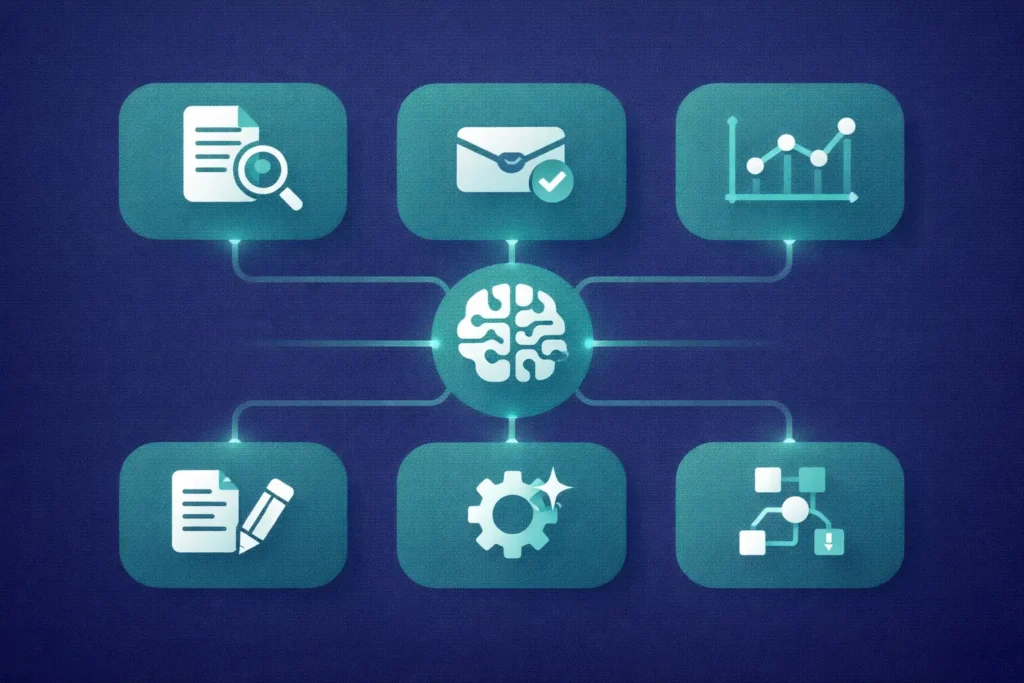
Invoices, contracts, forms, and reports arrive in dozens of formats. Manual processing is slow, error-prone, and expensive. Our AI workflows extract key data from unstructured documents, classify them by type and urgency, and route them to the right team or system. Whether you receive 50 documents per day or 5,000, the process stays consistent and accurate.
Customer Communication Workflows
Email triage consumes hours of skilled staff time every day. AI automation reads incoming messages, identifies the intent, and takes the right action. For simple requests, it drafts and sends a response. For complex issues, it creates a prioritized ticket with context. Consequently, your team focuses on work that requires human judgment rather than on sorting through inboxes.
Data Extraction and Reporting
Valuable business insights often hide in unstructured data — meeting notes, customer feedback, support logs, and survey responses. Our workflows automatically pull structured information from these sources. They generate summary reports, flag anomalies, and feed insights directly into your dashboards or business intelligence tools.
Content Generation Pipelines
Marketing copy, product descriptions, internal documentation, and weekly reports all follow repeatable patterns. AI workflows generate first drafts based on templates, data inputs, and brand guidelines. Human review remains part of the process, but the heavy lifting happens automatically. This approach typically reduces content production time by 60-80%.
Internal Tool Enhancement
You do not need to replace your existing tools. Instead, we add AI capabilities on top of them. Your CRM gains intelligent lead scoring. Your project management tool gets automated status summaries. Your internal wiki becomes searchable by natural language. These enhancements work through API integrations, so your team keeps the tools they already know.
Multi-Step Business Processes with AI Decision Points
Some workflows require multiple decisions across several steps — order approval chains, compliance checks, or vendor evaluations. Traditional automation needs a rule for every possible path. AI decision points handle ambiguity and edge cases that rule-based systems cannot. They evaluate context, apply business criteria, and escalate only when confidence is low.
Our Automation Stack
We use a proven combination of tools, each chosen for a specific strength. Together, they form a flexible platform that handles everything from simple two-step automations to complex multi-model workflows.
n8n for Visual Workflow Orchestration
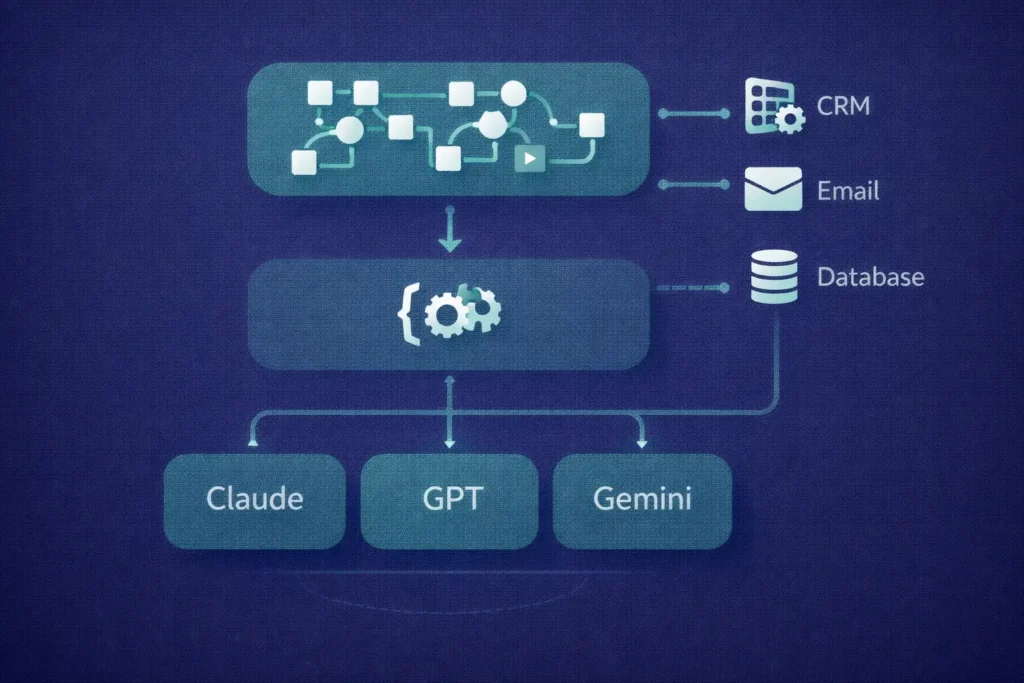
n8n is our primary orchestration tool for AI workflows. It provides a visual interface where business logic becomes a clear, editable diagram. Non-technical stakeholders can see exactly what each workflow does. Moreover, n8n supports self-hosting, which means your data stays on your infrastructure. We wrote extensively about this in our guide to building AI agent-to-agent workflows with n8n.
Custom Laravel Middleware
When workflows require complex business logic, validation, or database operations, we build custom middleware in Laravel. This handles authentication, data transformation, rate limiting, and integration with your existing application layer. Laravel also manages prompt templates, response caching, and fallback logic for AI model calls.
AI Model Integration with Cost Controls
Every AI model call in our workflows includes cost tracking and budget controls. We route requests to the most cost-effective model for each task. Simple classification might use a lightweight model, while complex analysis uses a more capable one. Additionally, we implement caching, batching, and prompt optimization to minimize token usage without sacrificing quality.
API Connections and Multi-Provider AI Support
Our automations connect to your existing business tools through APIs — CRM systems, ERP platforms, email services, cloud storage, and databases. On the AI side, we support multiple providers, including Anthropic Claude, OpenAI GPT, and Google Gemini. This multi-provider approach protects you from vendor lock-in and ensures you always have access to the best model for each task.
AI Agents for Business
AI agents are a step beyond simple automation. While a standard workflow follows a predefined path, an agent can plan, research, and adapt its approach based on what it finds. Think of the difference between a vending machine and a personal assistant. Both deliver results, but the assistant handles unexpected situations.
However, agents are not always the right choice. A simple chatbot that answers FAQs does not need agent capabilities. An email autoresponder does not either. Agents make sense when tasks involve research, multi-step reasoning, or decisions that depend on variable context. For example, an onboarding agent can gather customer information, check it against multiple systems, identify missing documents, and create a personalized setup plan — all without human intervention.
Other practical agent use cases include competitive research aggregation, automated report generation from multiple data sources, and intelligent customer triage that resolves common issues before escalating to support staff. According to Gartner, 40% of enterprise applications will include AI agents by late 2026 — up from less than 5% in 2025. The shift is already underway.
We help businesses determine where agents add genuine value and where simpler automation is more appropriate. You can read more about this in our articles on AI agents for business automation and how AI agents are replacing traditional SaaS tools.
Cost and ROI
AI automation delivers measurable returns, but timelines vary by complexity. Simple document-processing or email-triage workflows often show positive ROI within 4-8 weeks of deployment. More complex multi-step automations typically reach breakeven within 3-6 months. The key factor is volume — the more repetitive work the automation handles, the faster the payback.
We build cost controls into every automation from the start. This includes per-workflow budget caps, model routing based on task complexity, response caching for repeated queries, and detailed usage dashboards. You always know exactly what your AI automation costs — and can set hard limits to prevent surprises.
Our approach to cost management is not an afterthought. We published a detailed guide on reducing AI and LLM costs for businesses, and every technique in that guide is one we apply in production. Similarly, our analysis of AI chatbot cost and ROI provides a realistic framework for evaluating automation investments before committing budget.
Frequently Asked Questions
Most repetitive processes that involve reading, classifying, or generating text are strong candidates. Common examples include invoice processing, email triage, customer onboarding, report generation, data extraction from documents, and content creation. The best candidates are high-volume tasks where consistency matters and where manual processing creates bottlenecks.
Traditional automation follows exact rules — if X then Y. It works well for structured data and predictable scenarios. AI automation understands context and handles variability. It can read an invoice regardless of format, classify a customer request by intent rather than keyword, and make judgment calls on edge cases. The two approaches complement each other, and we often combine them in a single workflow.
n8n is an open-source workflow automation platform with a visual editor. We use it because it supports self-hosting (your data stays on your infrastructure), integrates with hundreds of business tools through pre-built connectors, and provides a clear visual representation of each workflow. Non-technical stakeholders can review and understand the automation logic. It also natively supports AI model integration, making it ideal for intelligent workflow orchestration.
Simple automations like email triage or document classification often show positive ROI within 4-8 weeks. More complex multi-step workflows typically reach breakeven within 3-6 months. The primary driver is volume — automations that handle hundreds of tasks per day pay back faster than those handling a few per week. We provide realistic ROI projections during the planning phase, before any development begins.
Start Automating Your Business Processes
Whether you want to automate a single repetitive task or transform an entire business process, we can help. Book a free 30-minute consultation with our team. We will assess your current workflows, identify the highest-impact automation opportunities, and give you a realistic estimate of costs and timelines. No obligation, no jargon — just a practical conversation about what AI automation can do for your business.