
AI opportunities are everywhere — in customer service, operations, content, and product development. If you are considering AI consulting for business, however, choosing the wrong opportunity wastes months of effort and budget. The difference between a successful AI project and a failed one almost always comes down to planning. That is why we separate consulting from development. Before writing any code, we help you understand where AI fits, what it costs, and whether it is worth the investment.
Pegotec has been building business software for nine years. Our AI solutions are backed by real implementation experience — not theoretical frameworks. We have delivered AI integrations across industries, and every engagement starts with the same question: where will AI create the most measurable value for your business?
This structured approach protects your budget. It also accelerates development, because teams that plan well build faster. Our consulting phase typically takes two to four weeks and produces a clear, actionable roadmap you can execute with confidence.
What AI Consulting Covers
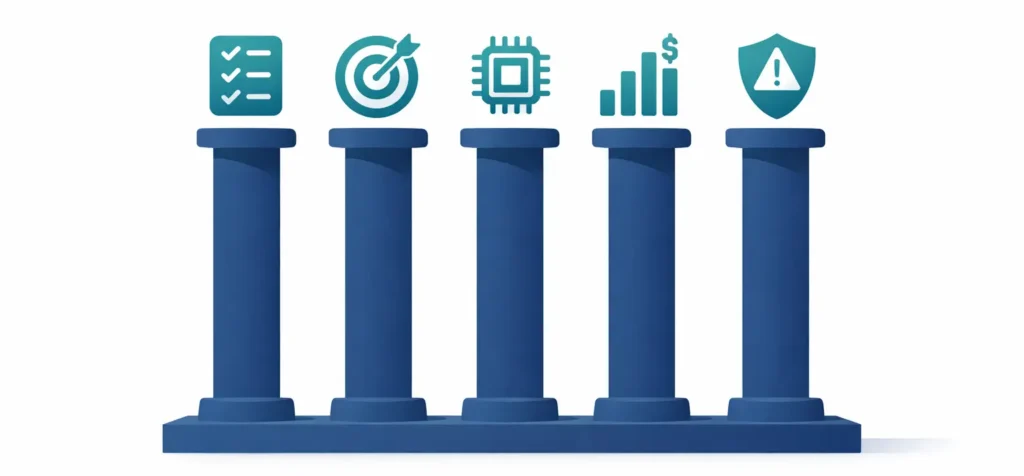
Our AI consulting service evaluates your business from five angles. Each one addresses a specific risk that causes AI projects to fail. Together, they give you a complete picture before any development begins.
AI readiness assessment. We evaluate your existing systems, data infrastructure, and team capabilities. Many businesses assume they need to overhaul everything before starting with AI. In reality, most modern web applications already have the foundation they need. We identify what is ready, what needs adjustment, and what would require significant investment.
Opportunity identification. Not every process benefits equally from AI. We analyze your workflows, customer interactions, and internal operations to find the highest-impact opportunities. Some tasks are better solved with simple automation. Others genuinely benefit from intelligent processing. We help you tell the difference.
Technology selection. The AI landscape changes monthly. Choosing between Claude, GPT, Gemini, open-source models, or fine-tuned alternatives requires understanding your specific use case — not following trends. We recommend the right models, providers, and architecture patterns based on your requirements, budget, and compliance needs.
Cost-benefit analysis. AI has both upfront development costs and ongoing operational costs. We provide realistic ROI projections that include API usage, infrastructure, maintenance, and the opportunity cost of not automating. As a result, you can make informed decisions with clear numbers — not optimistic estimates.
Risk assessment. What can go wrong with an AI implementation? Data privacy concerns, model accuracy limitations, vendor lock-in, cost overruns, and user adoption challenges are all real risks. We identify them early and build mitigation strategies into the roadmap. This prevents surprises during development.
Our Consulting Process
Every engagement follows four structured steps. This process keeps the timeline short, the scope clear, and the deliverables actionable.
Step 1: Discovery Workshop
We start with a focused workshop involving your key stakeholders. The goal is to understand your business objectives, current pain points, and what success looks like. We do not jump to solutions in this phase. Instead, we listen carefully and map your priorities. This workshop typically takes half a day and sets the direction for everything that follows.
Step 2: Technical Assessment
Next, our engineers review your existing systems, data sources, and infrastructure. We evaluate API capabilities, data quality, security requirements, and integration points. This step determines what is technically feasible and what constraints we need to work within. If your data needs preparation, we include that in the roadmap.
Step 3: Opportunity Mapping
Based on the discovery and technical assessment, we identify three to five AI use cases ranked by business impact. Each use case includes an effort estimate, expected benefit, and confidence level. We present these as a prioritized list so you can choose where to start. Some clients begin with a single high-confidence opportunity. Others pursue two or three in parallel.
Step 4: Roadmap Delivery
The final deliverable is a phased implementation plan. It includes development timelines, cost estimates (both upfront and ongoing), technology recommendations, resource requirements, and expected ROI for each phase. You receive a document you can take to your board, your investors, or your development team. It answers the question: “What exactly are we building, what will it cost, and what will we gain?”

Common AI Questions We Help Answer
Decision-makers come to us with practical questions. These are the ones we hear most often — and the consulting phase is designed to answer each of them with clarity.
“Should we build or buy AI capabilities?” The answer depends on your use case, data sensitivity, and long-term strategy. Off-the-shelf AI tools work well for generic tasks. Custom-built solutions deliver more value when your requirements are specific or your data is proprietary. We evaluate both options honestly and recommend the path that fits your business.
“Which AI model is right for our use case?” Model selection is one of the most impactful decisions in any AI project. Choosing the wrong model means overpaying for capabilities you do not need — or underperforming on tasks that matter. We published a detailed AI model selection guide that covers this topic in depth. During consulting, we apply this framework to your specific situation.
“Should we self-host or use API services?” Self-hosting gives you control over data and costs at scale. API services offer faster deployment and lower upfront investment. The right choice depends on your volume, compliance requirements, and technical capacity. Our self-hosted vs. API comparison breaks down the trade-offs and helps you decide based on your numbers.
“How do we control ongoing AI costs?” AI operating costs can grow quickly without proper architecture. Prompt caching, model tiering, response length controls, and smart routing are all techniques that significantly reduce costs. We have documented these strategies in our guide to reducing AI costs — and we apply every one of them in practice. Cost control is part of every roadmap we deliver.
Industries We Serve
Our AI consulting experience spans several sectors. While the technology is similar, each industry has different compliance requirements, data challenges, and user expectations. Here is where we bring the most value.
Government and NGOs. Public sector organizations benefit from AI in document processing, citizen communication, and data analysis. We understand the compliance and transparency requirements that come with government projects. Additionally, we design solutions that work within existing infrastructure constraints.
Healthcare. AI can improve patient communication, automate administrative tasks, and support clinical decision-making. However, healthcare data is sensitive. We factor in regulatory compliance, data residency, and privacy requirements from the start. Every recommendation accounts for these constraints.
Business operations and workflow automation. Companies with repetitive manual processes see the fastest ROI from AI. Document classification, invoice processing, customer triage, and report generation are high-impact use cases. We help operations teams identify which processes to automate first.
Customer-facing applications and SaaS. Products that serve end users can benefit from intelligent search, personalized recommendations, chatbot support, and natural language interfaces. We help product teams evaluate where AI improves the user experience — and where it adds unnecessary complexity.
Frequently Asked Questions
An AI consulting engagement includes a discovery workshop, a technical assessment of your systems and data, opportunity mapping with three to five ranked use cases, a cost-benefit analysis, a risk assessment, and a phased implementation roadmap. You receive a detailed document covering technology recommendations, timelines, cost estimates, and expected ROI.
Most consulting engagements take two to four weeks, depending on the complexity of your systems and the number of stakeholders involved. Simple assessments with a clear scope can be completed in two weeks. Larger organizations with multiple systems and departments may need four weeks for thorough evaluation and roadmap delivery.
No. Part of the consulting process is evaluating your current data situation. We assess what data you have, its quality, accessibility, and whether it needs preparation before AI can use it effectively. If your data needs cleaning or structuring, we include that as a phase in the implementation roadmap. You do not need perfect data to begin the conversation.
After consulting, you receive a complete roadmap and can decide how to proceed. Most clients move into the development phase with Pegotec, starting with the highest-priority use case identified during the consulting phase. However, the roadmap is yours — you can also use it to brief an internal team or another vendor. There is no lock-in. If you proceed with us, the consulting insights feed directly into sprint planning and architecture decisions.
Start with a Conversation
AI consulting begins with a simple conversation about your business goals. There is no obligation, no sales pitch — just an honest discussion about what AI can and cannot do for your situation. Book a free 30-minute consultation with our team and find out whether AI is the right investment for your business.