
In today’s fast-paced digital world, the demand for more innovative, more agile software solutions continues to rise. Companies want to build and deploy applications faster, scale easily, and respond to changes quickly. This is where microservices in software development come into play. Increasingly, businesses are shifting away from traditional monolithic systems and adopting microservices for enhanced flexibility and efficiency.
“The smaller the service, the more you maximize the benefits and downsides of microservice architecture.”
Sam Newman
What Are Microservices?
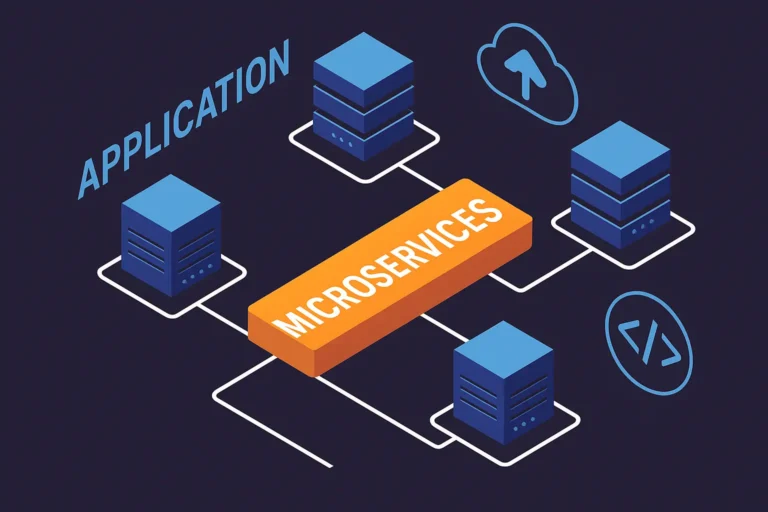
Microservices are a modern approach to software design. Instead of building a single, extensive application where every feature is tightly coupled, developers break it down into smaller, independent services. Each service handles a single function and operates independently, a key aspect of microservices in software development.
For example, an e-commerce platform could have separate services for user accounts, product catalogs, payments, and shipping. As a result, each one can be updated, tested, or scaled independently without touching the rest of the system.
Why Are Microservices in Software Development Gaining Ground?
In fact, the shift to microservices is not just a trend—it’s a practical solution to many long-standing challenges in software development. Let’s explore why microservices in software development are gaining prominence and being widely adopted.
Scalability Without Limits
Microservices enable teams to scale only the parts of the system that require additional resources. If your payment system is handling more traffic than your catalog, you can scale just that component. Consequently, this saves resources and avoids overloading the entire system.
Faster Development and Deployment
With microservices, different teams can work on separate services simultaneously. This means faster updates, quicker bug fixes, and reduced overall development time. Furthermore, it supports continuous deployment and more rapid product cycles, highlighting the role of microservices in advancing software development.
Higher System Resilience
In a monolithic application, a single bug can crash the entire system. In contrast, in a microservices setup, only the affected service is brought down, while the rest of the application continues to run. This makes troubleshooting easier and keeps your users happy, further demonstrating the value of microservices in software development.
Technology Flexibility
Microservices enable your teams to select the most suitable tools for each task. For instance, one service might run on PHP, another on Node.js, and yet another on Python. You are not locked into a single stack, which encourages innovation and better performance.
Easier Maintenance
When each part of your application is separate, making updates becomes much simpler. Moreover, developers can make changes to one service without risking the stability of the others. This leads to quicker releases and fewer system-wide issues. Ultimately, it’s one reason microservices are revolutionizing software development processes.
When Microservices Are Not the Right Fit
While microservices offer clear advantages, they are not the right solution for every project. In fact, industry leaders, including Amazon and Segment, have publicly documented cases where teams moved back from microservices to simpler architectures. Instead, the “modular monolith” approach—a well-structured single application with clearly separated internal modules—has gained significant traction as a pragmatic middle ground.
Specifically, microservices introduce operational complexity: distributed debugging, network latency between services, and the need for robust monitoring and orchestration. For small teams, early-stage products, or applications with tightly coupled domains, this overhead can outweigh the benefits. Therefore, at Pegotec, we help clients evaluate their specific situation and choose the architecture that truly fits—whether that is microservices, a modular monolith, or a phased migration that starts simple and evolves as the business grows.
How Pegotec Helps You Succeed with Microservices
At Pegotec, we believe in building future-ready digital solutions. Our team of software engineers and consultants has deep experience in designing and implementing microservices for businesses across industries. Whether you are building a web platform, a mobile app, or a cloud-based backend, we make the transition to microservices smooth and effective.
We start by understanding your business goals. Then, we assess your current systems to identify how microservices can enhance performance, agility, and cost efficiency. From planning through development and deployment, we guide you every step of the way in microservice-based software development.
Additionally, we utilize proven tools and platforms, such as Docker, Kubernetes, and API gateways, to ensure that your microservices work together securely and reliably. Our DevOps practices ensure that updates happen smoothly without downtime.
Real Benefits for Your Business
Microservices are not just for tech giants. Indeed, startups, mid-sized businesses, and large enterprises can all benefit from this approach. With Pegotec, you gain a long-term technology partner that supports microservices throughout the software development lifecycle.
- Reduce time to market.
- Increase the reliability of your systems.
- Adapt faster to business and user needs.
- Optimize infrastructure costs.
- Improve developer productivity.
Our clients in Singapore, Cambodia, the Philippines, Nepal, and Sri Lanka already enjoy the advantages of microservices thanks to Pegotec’s tailored solutions. We don’t just deliver code—we provide success.
Ready for the Next Step of Microservices in Software Development?
As digital transformation becomes more essential, adopting the exemplary architecture is key. Microservices empower you to build systems that grow with your business. Moreover, they let you move quickly, stay resilient, and keep your users satisfied.
At Pegotec, we help you move away from outdated, rigid systems and build flexible, high-performing microservice-based applications. Let us show you how modern architecture can boost your growth and keep you competitive. Contact us today to discuss why Microservices are Revolutionizing Software Development and how they can be applied to your project.
Frequently Asked Questions About Microservices in Software Development
Microservices are a way of designing applications as a collection of small, independent services. Each service focuses on a single function and can be developed, tested, deployed, and scaled separately.
Microservices allow you to scale only the parts of your system that need more resources. This targeted scaling saves costs and prevents unnecessary strain on the entire application.
With microservices, different teams can work on separate services simultaneously. This parallel development leads to quicker updates, faster bug fixes, and shorter release cycles.
Yes. In a microservices architecture, if one service fails, the rest of the system can continue running. This reduces downtime and improves the user experience.
Absolutely. Microservices give you the flexibility to choose the best technology stack for each service. You can mix PHP, Node.js, Python, and other languages as needed.
No. Businesses of all sizes—from startups to large corporations—can benefit from microservices. They offer scalability, flexibility, and resilience that work for various industries.
Pegotec assesses your goals and current systems to design a microservices strategy. We handle planning, development, deployment, and ongoing support using tools such as Docker, Kubernetes, and API gateways.
Microservices reduce time to market, increase reliability, lower infrastructure costs, boost developer productivity, and help you adapt quickly to changes in business needs.
Yes. Microservices introduce operational complexity, including distributed debugging, inter-service communication overhead, and the need for robust monitoring. For small teams or early-stage products, a modular monolith—a well-structured single application with clearly separated modules—can deliver many of the same organizational benefits with less overhead. The right architecture depends on your team size, product maturity, and scaling requirements.
Let's Talk About Your Project
Enjoyed reading about Why Microservices Are Revolutionizing Software Development? Book a free 30-minute call with our consultants to discuss your project. No obligation.