
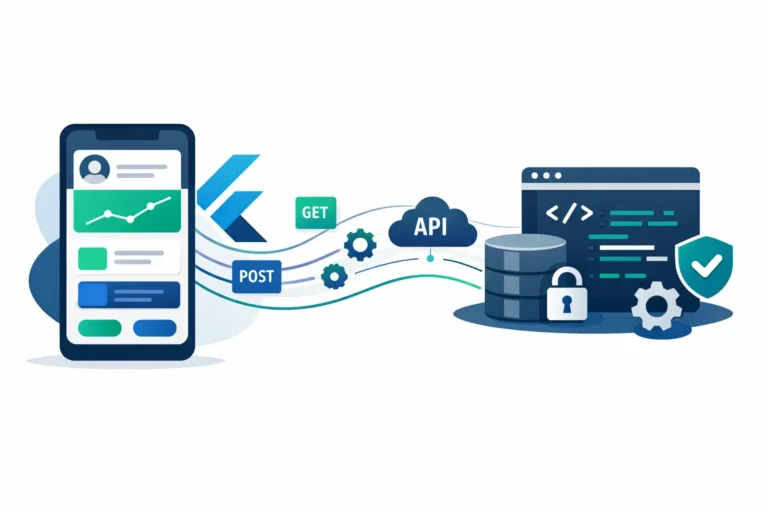
Modern mobile apps rely on a strong architecture to deliver fast, reliable user experiences. In 2026, the combination of Laravel, RESTful APIs, and Flutter has become one of the most effective full-stack approaches for building scalable mobile applications. Pegotec uses this Laravel Flutter API stack across client projects in Southeast Asia and beyond.
This architecture separates concerns cleanly. Laravel powers the backend logic and database operations. APIs handle communication between the server and the client. Flutter delivers beautiful, cross-platform mobile experiences on iOS and Android from a single codebase. Together, these three technologies create apps that perform well and scale reliably.
Why the Laravel Flutter API Stack Works in 2026
Each technology in this stack solves a specific problem. Laravel handles authentication, business logic, and data management. Flutter renders fast, native-like mobile interfaces. The API layer ensures both sides communicate efficiently without tight coupling.
This separation provides immediate advantages. First, frontend and backend teams can work independently. A Flutter developer updates the mobile UI while a Laravel developer refines a database query. Neither blocks the other. Consequently, development cycles become shorter and more predictable.
Additionally, this architecture supports multiple frontends from a single backend. The same Laravel API can serve a Flutter mobile app, a React web dashboard, and a third-party integration simultaneously. Businesses avoid rebuilding backend logic for each platform.
Laravel as the Backend Powerhouse
Laravel 13 continues to dominate PHP backend development in 2026. Its elegant syntax, built-in authentication, and powerful ORM make it ideal for mobile app backends. Pegotec builds Laravel backends that handle thousands of concurrent API requests without performance degradation.
For mobile app backends specifically, Laravel excels in several areas. Its Sanctum package provides lightweight API token authentication, perfect for mobile clients. Laravel Queues handle resource-intensive tasks, such as push notifications and image processing, in the background. Moreover, Laravel’s migration system maintains database schema consistency across development, staging, and production environments.
Laravel also simplifies complex business logic. Features such as Eloquent relationships, policy-based authorization, and event broadcasting map directly to clean API endpoints. The result is a backend that mobile developers can consume without confusion.
Designing APIs That Mobile Apps Love
The API layer determines how well your frontend and backend work together. Poorly designed APIs create slow, frustrating mobile experiences. Well-designed APIs make development faster and apps more responsive.
Pegotec follows specific API design principles for mobile clients. We use RESTful conventions with consistent URL patterns and HTTP methods. Response payloads stay lean because mobile devices operate on limited bandwidth. Pagination prevents oversized responses from draining battery and data.
Furthermore, we implement API versioning from day one. Mobile apps live on user devices and cannot update instantly like web apps. As the backend evolves, older app versions must continue to function. Versioned endpoints like /api/v1/ and /api/v2/ ensure backward compatibility without breaking existing installations.
API documentation matters equally. Pegotec uses tools such as Swagger to automatically generate interactive API documentation. This documentation serves as the contract between the backend and mobile teams. Both sides reference the same source of truth throughout development.
Flutter for Cross-Platform Mobile Excellence
Flutter continues to raise the bar for cross-platform mobile development in 2026. With version 3.41 released in February 2026, Google’s framework compiles to native ARM code, delivering performance that rivals apps built with platform-specific tools. A single Dart codebase produces iOS and Android apps that look and feel native on both platforms.
For API-driven apps, Flutter integrates seamlessly with Laravel backends. The Dio HTTP package handles API calls with interceptors for authentication tokens and error handling. Flutter’s state management options, including Riverpod and BLoC, organize API data efficiently across screens and widgets.
Additionally, Flutter’s hot reload feature significantly accelerates development. Developers see UI changes instantly without losing application state. When connecting to a Laravel API, this means rapid iteration on how data appears in the mobile interface. Pegotec’s Flutter developers typically deliver functional prototypes within the first sprint.
Real-World Architecture Decisions
Theory guides architecture, but real projects demand practical trade-offs. Pegotec has refined this stack through dozens of client engagements across healthcare, logistics, and government sectors.
Authentication flows require careful planning. We implement OAuth 2.0 with Laravel Sanctum and automatically manage token refreshes in Flutter. Users stay securely logged in without session interruptions. This approach works reliably even on unstable mobile connections.
Offline support presents another practical challenge. Not every user has constant internet access. Flutter’s local storage, combined with sync queues, lets apps function offline. Once connectivity returns, the app synchronizes pending changes with the Laravel backend via the API layer. This pattern proves essential for apps deployed in rural Southeast Asia.
Moreover, performance monitoring spans all three layers. We monitor Laravel response times, API error rates, and Flutter rendering performance in production. This visibility helps identify bottlenecks quickly, whether they originate in database queries, API serialization, or mobile rendering.
How Pegotec Builds Laravel Flutter API Projects
Pegotec follows a structured approach for full-stack mobile projects. We begin with API design workshops where backend and mobile teams define endpoints together. This collaborative start prevents miscommunication and rework later in the project.
Our development process runs in parallel streams. The Laravel team builds and tests API endpoints while the Flutter team develops screens with mock data. Integration happens continuously rather than at the end. As a result, issues surface early when they cost less to fix.
After launch, Pegotec provides ongoing maintenance for all three layers. Laravel dependencies receive regular security updates. API contracts evolve through versioning without breaking existing users. Flutter apps stay compatible with the latest iOS and Android releases. This comprehensive support keeps the entire stack healthy and up to date.
Conclusion
The Laravel Flutter API architecture delivers a practical, scalable approach to mobile app development in 2026. Laravel provides a robust backend. Clean API design ensures smooth communication. Flutter delivers beautiful cross-platform mobile experiences. Together, they form a stack that Pegotec trusts for projects across Southeast Asia and internationally.
Whether you need a customer-facing app, an internal business tool, or a data-driven mobile platform, this architecture adapts to your requirements. Contact Pegotec today to discuss how a Laravel Flutter API solution can bring your mobile app idea to life.
FAQ Section About Laravel Flutter API
Laravel Sanctum generates secure API tokens that Flutter stores on the device. The app automatically attaches these tokens to every API request. Token refresh happens in the background, keeping users logged in without interruptions or security compromises.
Yes. A single Laravel API backend can serve multiple frontends simultaneously. Flutter consumes the same endpoints as a React or Vue.js web dashboard. This shared backend eliminates duplicate business logic and reduces maintenance effort across platforms.
A typical Laravel Flutter API project takes three to six months from discovery to launch. Simple apps with core features can ship faster. Complex apps with offline support, real-time features, and third-party integrations require additional development time. Pegotec delivers working features in iterative sprints throughout the project.
Flutter compiles to native ARM code, delivering performance comparable to platform-specific development. Apps built with Flutter consistently achieve 60fps or higher rendering on modern devices, including 120fps on high-refresh-rate displays. Google, BMW, and Alibaba use Flutter in production apps serving millions of users worldwide.
API versioning protects existing app users from breaking changes. Pegotec implements versioned endpoints from day one. When the backend evolves, older app versions continue to function on the previous API version, while new app releases connect to updated endpoints.
Let's Talk About Your Project
Enjoyed reading about Building Full-Stack Mobile Apps with Laravel, APIs, and Flutter in 2026? Book a free 30-minute call with our consultants to discuss your project. No obligation.