
Laravel 13 officially launches on March 17, 2026 — and Pegotec will be using it from day one. As a software development company that has built on Laravel for years, we adopt every major release immediately. Not because it is new — but because those advantages flow directly to the businesses we serve. Laravel 13 is a particularly important release. It launches alongside the stable Laravel AI SDK, adds native passkey authentication, and upgrades without breaking existing projects.
What Is Laravel — and Why Does It Matter to You?
Laravel powers over 960,000 websites and holds more than 50% of the PHP framework market. It ranks first in the Stack Overflow Developer Survey for the fifth consecutive year. Consequently, major companies rely on it in production — including Disney+, Revolut, and Twitch. At Pegotec, Laravel is our primary framework for web applications, APIs, and enterprise platforms. In short, if we are building your software, it is almost certainly running on Laravel.
What Laravel 13 Brings to Your Business
Built-In AI Capabilities — From Day One
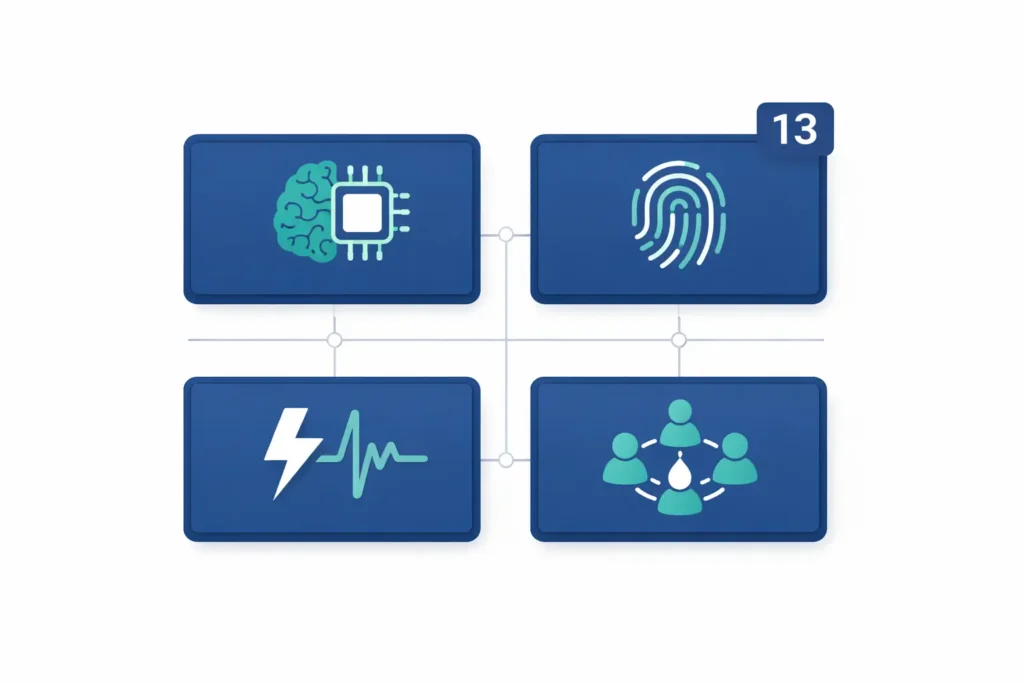
The most significant business development in Laravel 13 is not the framework itself — it is what launches alongside it. Simultaneously, the Laravel AI SDK exits beta as an officially supported, first-party toolkit for building AI-powered features inside any Laravel application. Your development team gains production-ready tools for intelligent search, document processing, AI chatbots, content generation, and workflow automation — built directly into your product.
Moreover, the SDK supports Anthropic, OpenAI, Google Gemini, and others simultaneously — with automatic fallbacks if one provider experiences outages. As a result, your application’s AI features remain available even when a single AI vendor has issues. You are also protected against vendor lock-in: switching providers requires changing a single configuration line, not rewriting your integration. For businesses evaluating whether to invest in AI features, this removes the two biggest blockers — integration complexity and provider risk.
Passwordless Security with Passkeys
Laravel 13 introduces native passkey authentication — the FIDO2 standard that replaces traditional passwords with device-bound cryptographic keys. In practice, your users log in with their fingerprint, face ID, or device PIN instead of a password. Consequently, the entire category of credential-stuffing and phishing attacks becomes irrelevant. Stolen password databases cannot be exploited if there are no passwords to steal. Furthermore, passkeys eliminate the most common customer support burden: password resets. For B2B platforms handling sensitive data, it also supports SOC 2 and ISO 27001 compliance — frameworks that increasingly mandate passwordless authentication.
Real-Time Features at Lower Infrastructure Cost
Laravel 13 adds a database driver to Laravel Reverb, the framework’s built-in real-time communication layer. Previously, scaling real-time features — live notifications, collaborative editing, live dashboards — required a separate Redis infrastructure tier. Now, the same real-time capabilities can run directly on your existing database. For most business applications, this eliminates an entire infrastructure component, reducing both monthly costs and operational complexity. High-traffic platforms can still use Redis when scale demands it — the choice is now optional rather than mandatory.
Multi-Team Support for SaaS Products
Laravel 13 ships with improved multi-team functionality in its starter kits. Specifically, users can now belong to multiple teams simultaneously. They can also switch between them across separate tabs — something the previous implementation could not support. For SaaS businesses where customers manage multiple organizations or workspaces, this resolves session conflicts that previously required custom workarounds.
Done right from day one, it saves weeks of development and eliminates a common source of frustration in B2B products.
PHP 8.3 and the Modern Foundation
Laravel 13 requires PHP 8.3 as its minimum runtime, dropping support for PHP 8.1 and 8.2. This matters for your business for one straightforward reason: PHP 8.1 reached end-of-life in December 2025, meaning it no longer receives security patches. Any application still running PHP 8.1 is running on an unsupported runtime with known, unpatched vulnerabilities. PHP 8.3, in contrast, receives security updates until November 2027. Additionally, PHP 8.5 — already released in November 2025 — is also supported by Laravel 13, bringing JIT compiler improvements and native URI handling for applications that want to leverage the latest runtime performance.
For business owners evaluating their vendors, asking “What PHP version are you deploying on?” is a legitimate quality signal. An agency deploying new projects on PHP 8.1 in 2026 is shipping software with a known security liability.
No Breaking Changes — What That Means for Existing Projects
Laravel 13 was deliberately designed with zero breaking changes at the framework level. All new features — including PHP Attributes, passkeys, and the Reverb database driver — are optional additions. Existing code continues to run without modification. Furthermore, Taylor Otwell confirmed at Laracon EU 2026 that the upgrade from Laravel 12 to 13 should be “really smooth and easy.” For businesses with applications already running on Laravel 12, this means the upgrade carries minimal risk and minimal development time.
In practice, the main consideration for upgrading is the PHP version requirement. If your current application runs on PHP 8.2, a runtime upgrade is necessary before moving to Laravel 13. This is straightforward for modern applications. Laravel 12 continues to receive bug fixes until August 2026 and security patches until February 2027, so there is no urgent pressure — but early adoption positions your application ahead of that security window and unlocks all Laravel 13 features immediately.
Why Day-One Adoption Gives You an Edge
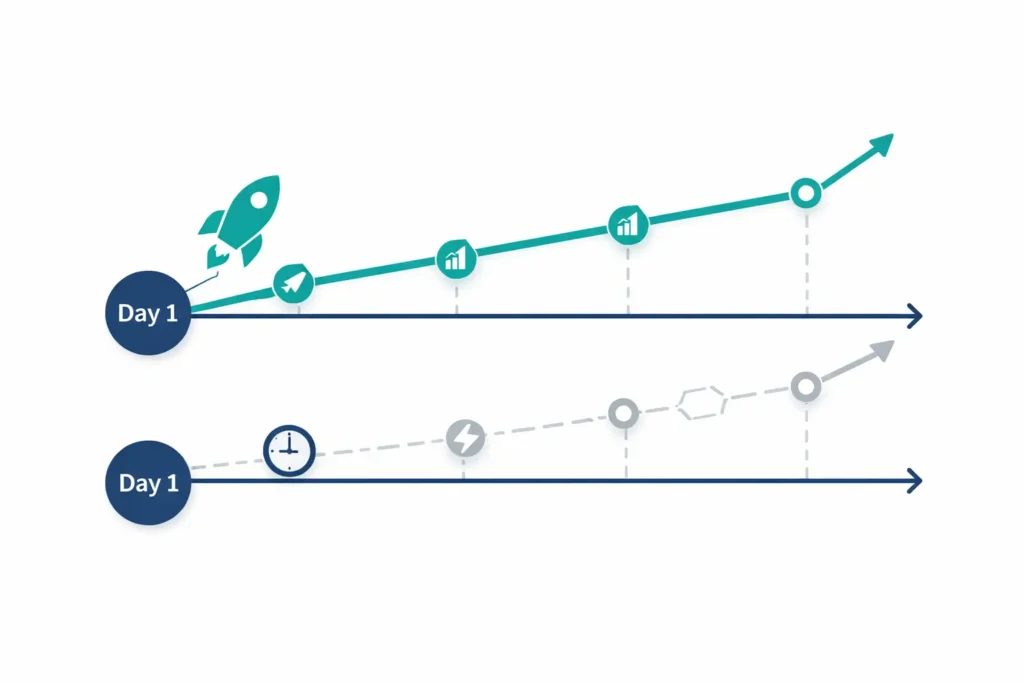
There is a compounding advantage to building on current technology from the first line of code. Specifically, every month spent on an older framework version is a month during which your product is unavailable to new tooling, security patches, and performance improvements. More importantly, the Laravel AI SDK going stable on the same day as Laravel 13 is a deliberate signal: the framework’s roadmap is now AI-first. Teams building on Laravel 13 from day one have immediate access to production-ready AI tooling. Teams waiting six months to upgrade spend that time building on a foundation that is already one step behind where the ecosystem is heading.
Additionally, the developer market reflects this. Senior Laravel engineers increasingly choose to work with teams running current framework versions. An agency or internal team running Laravel 10 in mid-2026 faces a real hiring disadvantage compared to one running Laravel 13.
For businesses that care about attracting and retaining software talent, the version of the framework their technology runs on is not a trivial detail.
How Pegotec Uses Laravel 13 for Your Project
At Pegotec, we have followed Laravel’s release cycle since the framework’s early versions. We adopt each major release immediately — not after a waiting period, not after other agencies have tested it first. Our team tracks the ecosystem closely, contributes to the community, and maintains the depth to implement new features correctly from day one.
New projects start on Laravel 13 with PHP 8.3, the Laravel AI SDK, and passkey authentication from the first sprint. On existing projects running Laravel 11 or 12, we assess the upgrade path and manage the PHP version transition. We then implement the features most relevant to your application — AI integration, real-time capabilities, or security improvements. Our support and maintenance service includes proactive framework version management, ensuring your application stays current without disruption to your users.
If you are evaluating whether your current software partner is keeping pace with the ecosystem — or planning a new product and want it built on the right foundation — contact Pegotec for a free consultation.
Conclusion
Laravel 13 is a well-timed, deliberately smooth release that brings three things of direct business value: production-ready AI capabilities through the official AI SDK, modern security through native passkeys, and a clean upgrade path with no breaking changes. Combined with PHP 8.3’s continued security coverage and PHP 8.5’s runtime improvements, it represents exactly the kind of foundation that serious software products should be built on in 2026. Pegotec is already here. If your software should be too, let’s talk.
Frequently Asked Questions About Laravel 13
Laravel 13 officially launches on March 17, 2026, as announced by Taylor Otwell at Laracon EU 2026. The release coincides with the stable launch of the Laravel AI SDK, making it one of the most significant Laravel releases in recent years.
The key business benefits are: (1) built-in AI capabilities via the stable Laravel AI SDK with multi-provider support and automatic fallbacks, (2) passkey authentication eliminating stolen-password attacks and password reset support burden, (3) real-time features without requiring separate Redis infrastructure, and (4) native multi-team support for SaaS products. All features are optional and backward-compatible.
No. Laravel 13 was designed with zero breaking changes at the framework level. All new features are optional additions — existing code continues to run without modification. The main requirement is PHP 8.3 as a minimum runtime. If your application currently runs on PHP 8.2, a runtime upgrade is needed first, which is straightforward for modern Laravel applications.
The Laravel AI SDK is Laravel’s official first-party toolkit for building AI-powered features. It provides a unified interface for text generation, image processing, embeddings, vector stores, web search, and AI agent workflows. Laravel supports multiple providers simultaneously — including Anthropic, OpenAI, and Google Gemini — with automatic provider fallbacks and full testability. It went stable on the same day as Laravel 13.
Laravel 13 requires PHP 8.3 as a minimum, dropping support for PHP 8.1 and 8.2. PHP 8.1 reached end-of-life in December 2025 (no more security patches), making this a security-driven requirement. Laravel 13 also supports PHP 8.4 and 8.5. For new projects, Pegotec defaults to PHP 8.3 or higher.
Laravel 13 receives bug fixes until approximately September 2027 (18 months from release) and security patches until March 2028 (24 months from release). This gives businesses a clear, predictable support window for planning upgrades. For comparison, Laravel 12 security patches end in February 2027.
Let's Talk About Your Project
Enjoyed reading about Laravel 13: What It Means for Your Business? Book a free 30-minute call with our consultants to discuss your project. No obligation.