
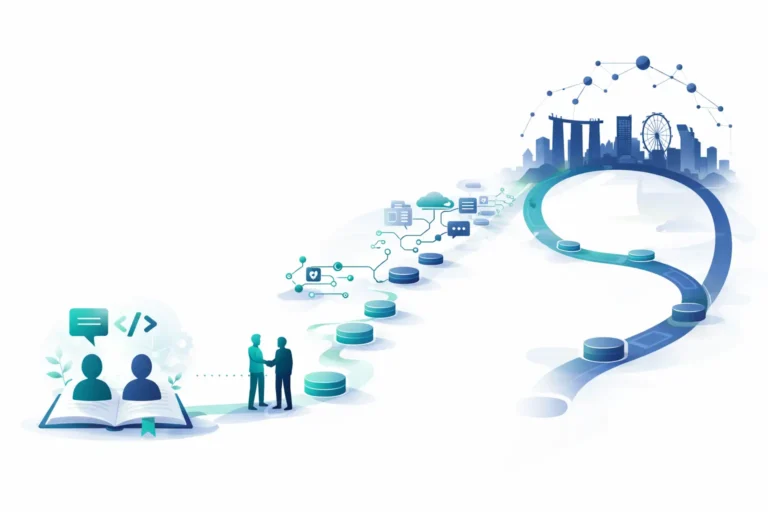
Pegotec Singapore turns nine this June. Since our incorporation in 2017, we have delivered software across seven countries for governments, international organizations, startups, and enterprises. Along the way, we learned lessons that no framework documentation or methodology book could teach us. These are the nine principles — one for each year — that shaped how we build software today.
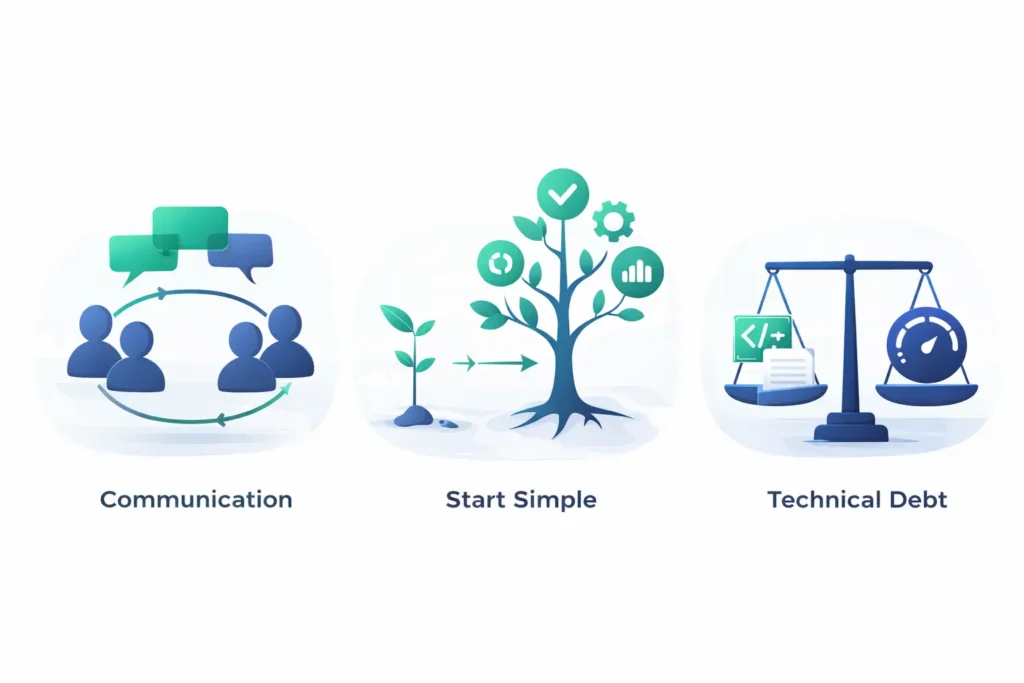
1. Communication Beats Documentation
Early in our journey, we believed detailed specification documents guaranteed project success. They did not. Specifications become outdated the moment stakeholders see a working prototype. Instead, we learned that consistent, honest communication — weekly check-ins, shared Slack channels, and direct access to developers — prevents more problems than any 50-page requirements document ever could. As a result, our methodology now prioritizes regular touchpoints over exhaustive upfront documentation.
2. Start Simple, Scale Smart
We have seen projects fail because they tried to build everything at once. The IDPoor App for Cambodia’s Ministry of Planning began as a focused mobile tool for household identification — not a comprehensive poverty management platform. That disciplined scope allowed us to launch, gather real field data, and iterate based on actual usage. Consequently, the application now serves millions of users across Cambodia, far beyond its original scope. Starting with a focused MVP consistently outperforms ambitious all-at-once approaches.
3. Technical Debt Is Real Debt
Every shortcut accumulates interest. We learned this lesson by maintaining applications over years, not months. A quick workaround in Sprint 3 becomes a two-week refactoring effort in Year 2. Therefore, we now allocate 15-20% of each sprint to deliberately addressing technical debt. This approach keeps codebases healthy and prevents the slow decline that makes legacy applications expensive to maintain. Clients who invest in regular maintenance consistently pay less over the lifetime of their software.
4. Design Before Development
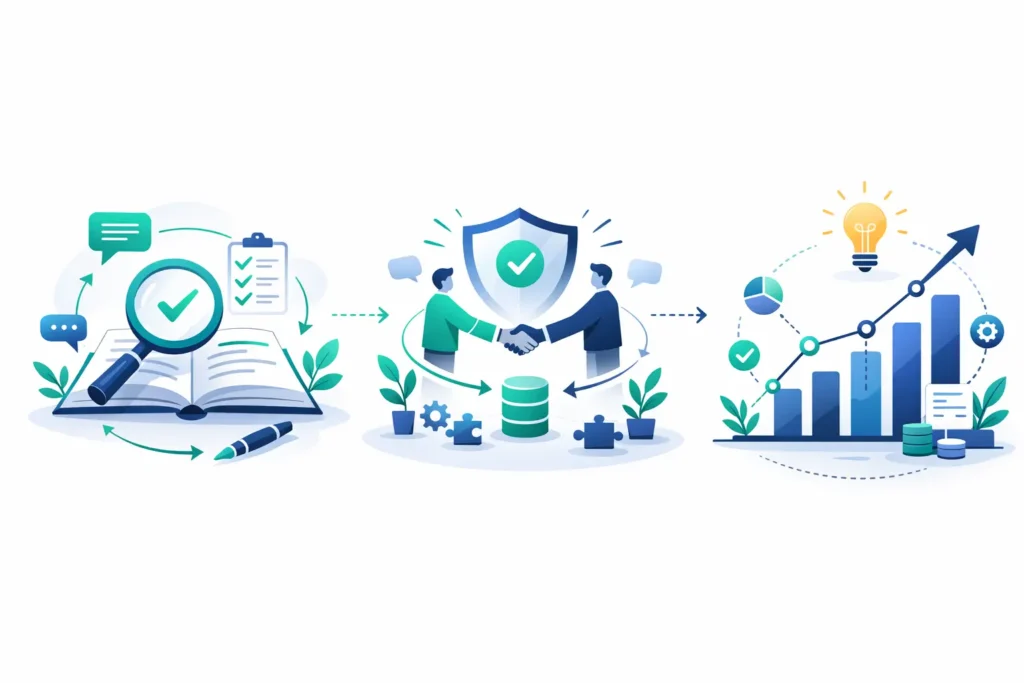
Our UI/UX design process used to run in parallel with development. That created constant rework when designs changed after features were already built. Now, we complete wireframes, user flows, and interactive prototypes before writing a single line of production code. For example, the BLCP Dental Hub — a Laravel, React, and Flutter application for dental care management in Cambodia — went through three prototype iterations before development began. The result was zero major design revisions during development, which saved weeks of rework.
5. Testing Is Not Optional
We once treated testing as a phase at the end of development. Bugs found late cost five to ten times as much to fix as those caught during development. Today, automated testing runs on every commit in our CI/CD pipelines. Unit tests, integration tests, and end-to-end tests form a safety net that gives us confidence to ship updates quickly. In 2026, we extended this pipeline with AI-assisted test generation and flaky-test detection. As a result, our coverage numbers now reach levels that once required much larger QA teams. Importantly, the discipline behind good testing still comes from humans. Moreover, this approach is especially critical for applications used by governments and international organizations, where data accuracy and system reliability directly affect vulnerable populations.
6. Long-Term Relationships Matter More Than Projects
Our most successful engagements — with GIZ, UNDP, CARE International, and others — span multiple years and multiple projects. These long-term partnerships enable us to understand an organization’s culture, technical landscape, and constraints in depth, which no onboarding process can replicate. Additionally, we retain institutional knowledge of their systems, reducing handover costs and accelerating new project delivery. Pegotec Singapore exists today because we chose to invest in relationships, not just deliverables.
7. Transparency Builds Trust
When something goes wrong — and it inevitably does — the worst response is to hide it. We have adopted radical transparency as a core operating principle. If a deadline is at risk, we communicate it immediately with a recovery plan. If a technical approach proves wrong, we say so before sunk costs accumulate. This honesty has occasionally lost us short-term credibility, but it has always built long-term trust. In fact, several of our strongest client relationships began with us delivering difficult news early and honestly.
8. Learn from Failures, Not Just Successes
Not every project went perfectly. We have experienced scope creep, underestimated complexity, and chosen the wrong technologies for specific use cases. The difference between a company that grows and one that stagnates is what happens after failure. We conduct retrospectives after every significant project — not to assign blame, but to capture what we would do differently. These lessons feed directly into our methodology and training, which means each new project benefits from every experience, including the difficult ones.
9. Stay Curious About Technology — But Choose Wisely
Our technology stack evolved significantly over the past nine years. We adopted Flutter early for cross-platform mobile development, embraced React for complex frontends, and built our backend expertise around Laravel and Node.js. Most recently, AI code assistants have reshaped our daily workflow. Specifically, they handle boilerplate, generate tests, and shorten the path through unfamiliar libraries. Notably, they are the largest single productivity shift we have seen in nine years. However, the same pragmatism applies: we read every generated line before merging it. Curiosity must be balanced with pragmatism. We evaluate new technologies through a practical lens: Does it solve a real problem for our clients? Does our team have the capacity to support it long-term? Can we hire or train for it? This disciplined approach ensures we adopt innovation without abandoning reliability.
Year Nine: The AI Shift
The past year deserves its own reflection. Specifically, AI has changed how we plan, build, test, deploy, and maintain software. Indeed, that shift arrived faster than any single technology in the previous nine years. However, the honest story is that the gains are real, measurable, and narrower than vendor headlines suggest. For example, boilerplate generation and test writing see 50 to 70 percent productivity gains. By contrast, novel algorithmic work and security-critical code still require the human judgment that defines good engineering.
Starting June 18, we begin publishing a five-part series on AI across the software development lifecycle. Specifically, the series covers planning, development, testing, deployment and DevOps, and maintenance — one article each Thursday through mid-July. Each article reflects what we actually practice at Pegotec Singapore — the same honest frame behind the nine lessons above.
Looking Ahead from Pegotec Singapore
Nine years, seven countries, and hundreds of projects have taught us that great software is built on relationships, honesty, and deliberate craftsmanship — not just code. As Pegotec Singapore enters its tenth year, these nine lessons remain the foundation of our operations. Our team continues to grow across Singapore, the Philippines, Cambodia, Nepal, India, Sri Lanka, and Germany, and every new team member inherits these principles on their first day.
Whether you are planning a new application, modernizing an existing platform, or exploring how emerging technologies like AI can improve your operations, we bring nine years of practical experience to the conversation. Contact Pegotec to discuss how we can help build your next project the right way.
Conclusion
These nine lessons reflect what we actually practice at Pegotec Singapore — not theoretical ideals. They emerged from real projects, real mistakes, and real relationships with clients who trusted us to build software that matters. As we approach our ninth anniversary on June 14, we share these lessons not as a celebration of past achievements, but as a commitment to the standards we hold ourselves to every day.
FAQ
Pegotec Singapore combines European management standards with Asia-Pacific delivery across seven countries. Our team has worked with governments, NGOs such as UNDP and GIZ, and enterprises for 9 years, building deep expertise across sectors such as healthcare, public services, and e-commerce.
Pegotec Singapore builds with Laravel and Node.js on the backend, React and Vue.js on the frontend, and Flutter for cross-platform mobile apps. We also work with PostgreSQL, MongoDB, GraphQL, and emerging technologies like AI integration and workflow automation.
Communication beats documentation. Consistent, honest communication — regular check-ins, direct developer access, and transparent progress updates — prevents more problems than any specification document ever could. This principle underpins every other lesson we have learned at Pegotec.
We allocate 15-20% of each sprint to deliberately addressing technical debt. This prevents the slow decline that makes legacy applications expensive to maintain. Clients who invest in regular maintenance consistently pay less over the lifetime of their software.
Pegotec is headquartered in Singapore with teams across seven countries: Singapore, the Philippines, Cambodia, Nepal, India, Sri Lanka, and Germany. This distributed structure allows us to serve clients across Asia-Pacific and Europe with local presence and cultural understanding.
Let's Talk About Your Project
Enjoyed reading about 9 Key Lessons from 9 Years of Software Development? Book a free 30-minute call with our consultants to discuss your project. No obligation.