
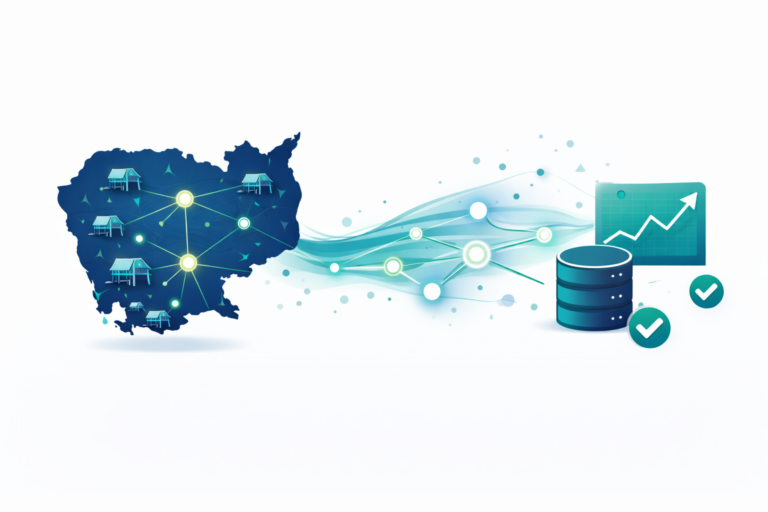
Some projects teach you more than others. The IDPoor system in Cambodia challenged everything we knew about building software for real-world conditions. This case study explores The IDPoor Story: Scaling to Millions of Users and how Pegotec partnered with GIZ to create a social protection platform that now serves millions of Cambodians nationwide.
Cambodian software development presents unique challenges that standard approaches cannot address. Unreliable internet connectivity in rural areas. Multiple languages, including Khmer script. Users with varying technical literacy. Government compliance requirements. The IDPoor project required us to solve all these challenges simultaneously.
Understanding the IDPoor System
IDPoor identifies and registers poor households across Cambodia. The system enables targeted delivery of social services to those who need them most. Before digitalization, this process relied on paper-based surveys and manual data entry. Information scattered across provincial offices made national coordination nearly impossible.
The German Development Cooperation, through GIZ, partnered with Cambodia’s Ministry of Planning to transform this system. Pegotec joined as the technical implementation partner. Our mission was clear: build a digital platform that works everywhere in Cambodia, including the most remote villages.
The scope exceeded typical enterprise software projects. The platform needed to support door-to-door household surveys in rural areas. It required integration with existing government databases. The interface needed to work in Khmer, the official language, with its unique script requirements. Most importantly, the system had to function without reliable internet access.
Technical Challenges in Cambodia Software Development
Rural Cambodia lacks consistent internet connectivity. Enumerators conducting household surveys often work in areas with no cellular coverage. Traditional web applications would fail in these conditions. Therefore, we designed an offline-first architecture from the ground up.
The mobile application stores all necessary data locally. Enumerators can conduct complete surveys without any internet connection. Data synchronizes automatically when connectivity becomes available. Conflict resolution algorithms handle cases where multiple devices update duplicate records. This approach ensures no data loss regardless of network conditions.
Moreover, the Khmer language presented significant technical challenges. Khmer script uses complex character combinations that many software systems handle incorrectly. Text rendering, sorting, and search functionality all required special attention. We tested extensively with native Khmer speakers to ensure proper display across all devices and screen sizes.
Security requirements added another layer of complexity. The system contains sensitive personal information about vulnerable populations. Government regulations mandate strict data protection measures. We implemented role-based access controls, encrypted data storage, and comprehensive audit logging. Every action in the system creates an auditable record.
Scaling from Pilot to Nationwide Deployment
The project began with a pilot deployment in selected provinces. This initial phase allowed us to validate assumptions and identify unexpected challenges. Real-world testing with actual enumerators revealed usability issues that lab testing had missed. We iterated rapidly in response to this feedback.
Subsequently, we expanded province by province across Cambodia. Each expansion taught new lessons. Different provinces had different network conditions. Local variations in survey procedures required configurable workflows. Training programs needed adaptation for varying literacy levels among users.
The deployment team developed a systematic approach to provincial rollouts. Pre-deployment assessments identified local infrastructure challenges. Customized training programs addressed specific user needs. Post-deployment support ensured smooth transitions. This methodical approach enabled consistent quality across all provinces.
Today, the system operates nationwide. Thousands of trained enumerators use the platform regularly. Millions of household records exist in the centralized database. Government officials access real-time reports on poverty distribution across the country.
Lessons Learned from This Project
Nine years of software development taught us many lessons. The IDPoor project reinforced some and introduced others entirely new.
First, offline-first design should be the default for any application used in challenging environments. Retrofitting offline capabilities onto online applications rarely works well. Starting with offline assumptions creates a more robust architecture overall.
Additionally, localization extends far beyond translation. Khmer required us to rethink text handling at fundamental levels. Date formats, number systems, and cultural conventions all needed consideration. Treating localization as an afterthought would have created an unusable product.
Furthermore, user training determines project success as much as software quality. The most elegant application fails if users cannot operate it effectively. Investing in comprehensive training programs multiplied the value of our technical work.
Finally, government projects require patience and flexibility. Approval processes take time. Requirements evolve as stakeholders learn more about possibilities. Building trust with government partners requires consistent delivery over extended periods.
Impact and Outcomes
The IDPoor system transformed how Cambodia identifies and supports vulnerable populations. Digital records replaced paper files that were difficult to search and easy to lose. Real-time data enables faster response to emerging needs. Transparency increased as the system creates auditable records of all activities.
Integration with other government systems multiplied the impact. Social protection programs can now verify eligibility instantly—healthcare initiatives target services to those in need based on accurate poverty data. Educational support reaches students from registered poor households. The IDPoor database became foundational infrastructure for Cambodia’s social protection ecosystem.
International recognition followed the successful deployment. Development organizations studying digital transformation in developing countries reference the IDPoor system as a model implementation. The approach pioneered in Cambodia has influenced similar initiatives across Southeast Asia.
How Pegotec Approaches Complex Government Projects
The IDPoor experience shaped how Pegotec approaches similar challenges today. We begin with a deep understanding of real-world conditions before writing code. Pegotec designs for the worst-case scenarios that users will actually encounter. We invest in user research and testing with representative populations.
Our Cambodia software development expertise extends beyond this single project. We understand the regulatory environment, infrastructure limitations, and cultural considerations unique to the region. This knowledge accelerates new projects and reduces risk for clients operating in Cambodia and neighboring countries.
Building systems that serve millions requires different thinking than building typical business applications. Scale, reliability, and accessibility become paramount concerns. Pegotec brings this enterprise mindset to every project, whether serving thousands or millions of users.
Conclusion
The IDPoor project demonstrates what becomes possible when technology meets genuine commitment to social impact. Technical challenges that seemed insurmountable became opportunities for innovation. Offline-first architecture, multi-language support, and nationwide scale all proved achievable with the right approach.
Considering a project with similar complexity? Contact Pegotec to discuss how our experience with large-scale government systems can benefit your initiative.
FAQ Section About The IDPoor Story: Scaling to Millions of Users
IDPoor is Cambodia’s national poverty identification system. It registers and verifies poor households nationwide to enable targeted delivery of social protection services. The digital platform replaced previous paper-based processes with a modern, integrated system.
Offline-first applications store data locally on devices and synchronize with servers when internet connectivity becomes available. This approach ensures full functionality regardless of network conditions. Conflict resolution algorithms handle situations where multiple devices modify the same data.
Cambodia presents specific challenges, including unreliable rural internet connectivity, Khmer language support requirements, varying user technical literacy, and government compliance needs. Successful projects must address all these factors from the design phase onward.
The project followed a phased approach, starting with pilot provinces before expanding nationally. This methodical rollout allowed continuous improvement based on real-world feedback. The timeline included extensive training programs for thousands of end users.
Yes. The architectural patterns and lessons learned from IDPoor apply to similar challenges in other developing countries. Pegotec has experience adapting these approaches for different regulatory environments, languages, and infrastructure conditions across Southeast Asia.
Let's Talk About Your Project
Enjoyed reading about The IDPoor Story: Scaling to Millions of Users in Cambodia? Book a free 30-minute call with our consultants to discuss your project. No obligation.