
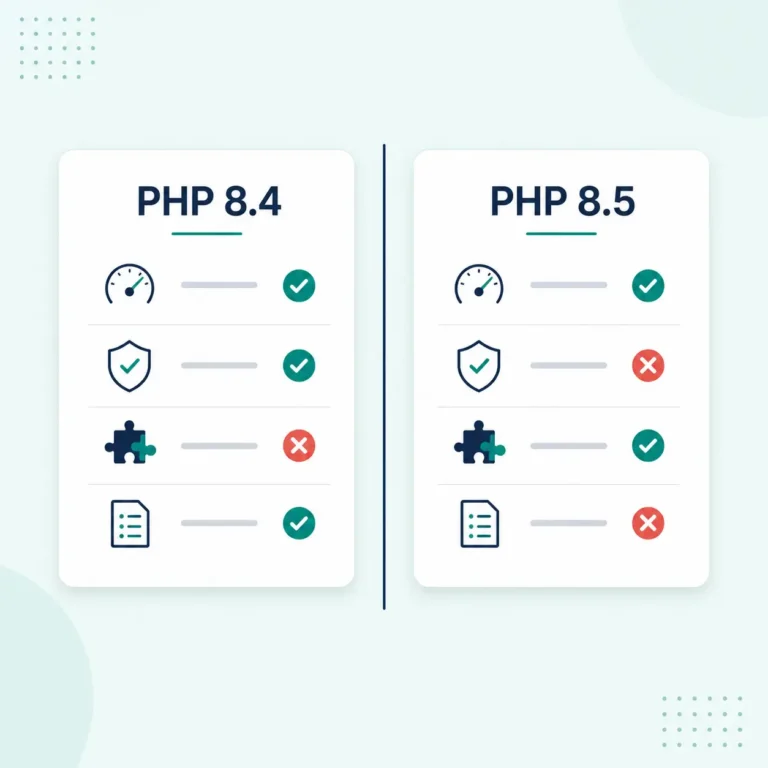
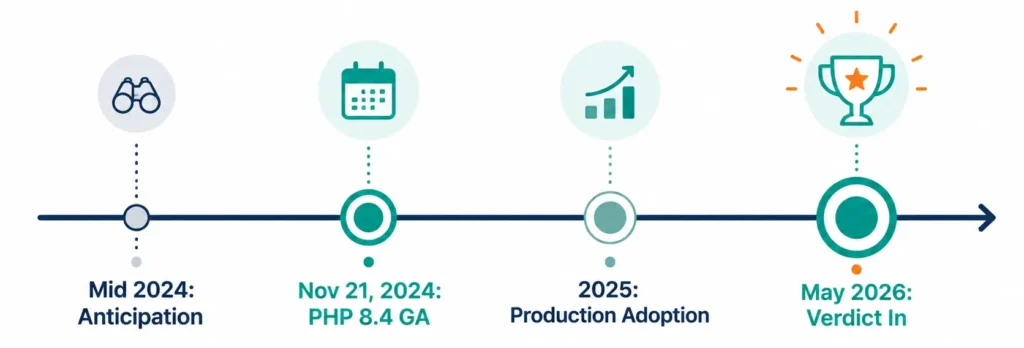
PHP 8.4 arrived on November 21, 2024. PHP 8.5 followed on November 20, 2025. By May 2026, teams will have run both versions in production at scale long enough to reach a clear verdict. The anticipation phase has passed. Real-world production data has replaced early-adopter benchmarks. The community has also identified which features deserve attention and which ones developers can safely ignore.
This guide cuts through the launch-day hype. We cover what both releases actually introduced. We also highlight which features make sense to adopt in 2026, which ones underperform, and how teams should sequence upgrade work for a typical Laravel application.
The short version: both releases deliver more practical value than the PHP 8.3 cycle. Several features genuinely improve how developers write everyday code.
What actually shipped in PHP 8.4
Three features dominated the 8.4 release and still matter most a year later. The rest are useful but secondary.
Property hooks — the headline feature
Property hooks let you attach getter and setter logic directly to a property without writing a separate method. Specifically, you can compute values lazily, validate on write, or transform on read with a single block of syntax. In practice, this collapses a common Laravel pattern. Previously, domain objects exposed explicit accessor methods around protected fields. The 2026 verdict is clear: adopt this in new code immediately. The syntax is stable, the runtime cost is negligible, and the readability win is real.
Asymmetric visibility
Asymmetric visibility lets you separate read and write access on the same property. For example, public(set) exposes the value to readers but restricts writes to the declaring class. As a result, you can replace a lot of boilerplate getter-only patterns with a one-line declaration. Use it freely. The semantics are simple, and the alternative — manual private fields with public getters — is uglier in every comparison.
Lazy objects via Reflection
Lazy objects defer construction until first use. Specifically, frameworks can hand you a placeholder. The placeholder resolves to a real instance only when a method or property is touched. Laravel’s container has used a similar trick for years. Notably, the 8.4 version makes the pattern part of the language. Verdict: useful for specific patterns, such as heavy domain objects or expensive integrations. However, it is easy to misuse it if you reach for it as a general performance trick. Try it in greenfield code first, not in a legacy refactor.
The rest of the 8.4 release
Several smaller additions in 8.4 still earn their place. Notably, the new #[Deprecated] attribute lets you mark functions and methods as deprecated in a way that static analyzers and IDEs can read. Furthermore, the new array helpers — array_find(), array_find_key(), array_all(), and array_any() — eliminate several common micro-patterns that previously required a foreach loop. Additionally, the HTML5 DOM parser landed, finally giving PHP a standard-compliant HTML parser without a third-party library. JIT improvements continued in 8.4, but the real-world impact on typical Laravel applications remains modest.
What actually shipped in PHP 8.5
The 8.5 release is smaller in scope than 8.4 but contains several features that change how everyday code reads.
The pipe operator
The pipe operator |> Finally landed after years of debate. It lets you chain function calls left to right without nesting them. For instance, $input |> trim(...) |> strtolower(...) reads cleanly compared to the nested equivalent. Verdict: powerful in functional code. However, the community style around it is still settling in 2026. Try it in greenfield projects where the team agrees on the convention. By contrast, avoid retrofitting it into legacy code where reviewers may not yet read the syntax fluently.
array_first and array_last
Two tiny additions that eliminate a surprisingly common micro-pattern. Instead of reset() plus current(), or array slicing tricks, you now write array_first($arr) and array_last($arr). Adopt these everywhere. There is no reason to skip them.
Clock interface in the core
PHP 8.5 added a Clock interface and a SystemClock implementation to the core. Specifically, this gives you a testable time abstraction without pulling in a library like lcobucci/clock symfony/clock. As a result, tests that depend on the current time can be affected by a fake clock. Verdict: Use it in new code that touches time. For existing codebases that already depend on a third-party clock library, the migration is optional — the third-party libraries are still maintained.
#[NoDiscard] attribute and error reporting
The #[NoDiscard] attribute lets you mark return values that should not be silently ignored. For example, marking a builder method or a result-type return value with the attribute triggers a compiler warning. Specifically, the warning fires when a caller forgets to use the result. Additionally, 8.5 improved stack traces and error reporting in ways that matter most when debugging production incidents. Both changes are quiet wins. In practice, they pay off over months, not on release day.
What to use right now in 2026
The opinionated short list — apply these immediately to greenfield work, and adopt as you touch existing files.
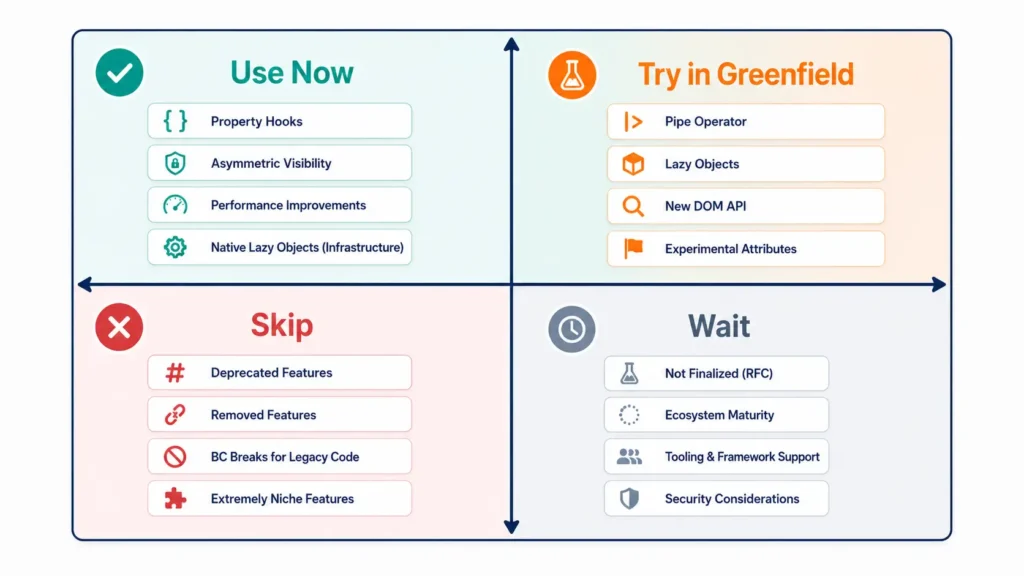
- Use immediately: property hooks, asymmetric visibility,
array_find/array_allfamily,array_first/array_last,#[Deprecated], the coreClockinterface. - Try in greenfield only: the pipe operator (community style not yet settled), lazy objects via Reflection (powerful but easy to misuse),
#[NoDiscard]on new APIs (less useful retrofitted to legacy code). - Skip or wait: chasing JIT-only optimizations, switching from a working third-party clock library to the core one, rewriting your HTML parsing layer to use the new DOM parser.
The pattern across both releases is consistent. Specifically, the features that improve everyday code shape — hooks, visibility, small array helpers, testable time — earn adoption. The features that promise system-level wins through compiler magic deliver less than the launch-day numbers suggested.
What got hyped but didn’t deliver
Three areas drew outsized attention at launch and produced muted results in production.
JIT performance. Both 8.4 and 8.5 continued the JIT improvements that started years ago. Real-world Laravel applications typically see five to eight percent throughput gains, not the headline numbers suggested by isolated benchmarks. For most teams, JIT is worth enabling but not worth a refactor.
The HTML5 DOM parser. Genuinely useful for new code that needs to parse HTML, but most teams have a working solution already. Migrating an existing scraper or template engine to the new parser rarely justifies the effort.
Property hooks edge cases. Although the headline feature works cleanly, several edge cases — hooks plus interfaces, hooks plus inheritance, hooks plus serialization — still trip teams up. The community is converging on patterns, but the documentation is uneven a year in.
Migration considerations
Both versions are backward-compatible at the source level for typical Laravel applications. However, a few specific changes need attention before the upgrade. Implicit nullable types — the long-deprecated function foo(?int $x = null) shorthand — was fully removed in 8.4. Additionally, several legacy mb_* aliases were removed in 8.5. Notably, static analyzers like PHPStan and Psalm catch both classes of issue quickly.
The recommended upgrade order for teams still on PHP 8.2 or 8.3 is straightforward. First, run a static analysis pass against your codebase. Second, upgrade to PHP 8.4 and run your test suite. Third, once 8.4 is stable in production, move to 8.5. Skipping 8.4 entirely is reasonable if you are far behind. Specifically, both 8.4 and 8.5 share most of the deprecations and removals, so a single jump is feasible. Real-world rollout: Most managed hosts support 8.4, generally available by mid-2025. Furthermore, 8.5 reached parity across major hosts in Q2 2026.
How Pegotec handles PHP upgrades
We treat PHP upgrades as a scheduled engineering activity rather than a one-off chore. Specifically, we run static analysis and the existing test suite against each candidate version. Then we fix the surfaced issues and deploy through staging before production. For Laravel applications, we sequence upgrades using the Laravel version pipeline. As a result, PHP, framework, and dependencies move together in defensible steps. Is your team weighing a jump from PHP 8.2 or 8.3 to 8.4 or 8.5 in 2026? Our AI Consulting and Strategy page covers the broader conversation on modernization. Additionally, you can contact our team for a no-obligation discussion of where to start.
Read next
If you found this useful, these adjacent guides go deeper:
- Laravel 13: What It Means for Your Business — the natural framework pairing with the PHP 8.5 jump.
- Keeping Your Web Application Up-to-Date: Why Laravel 12 and PHP 8.5 Matter — companion piece for teams still on Laravel 12.
- AI Search 2026: What actually works – and what doesn’t — the May 12 piece on getting your business cited inside ChatGPT, Claude, and Grok.
Frequently Asked Questions about PHP 8.4 and 8.5
Property hooks were introduced in PHP 8.4. They collapse a common pattern in which domain objects expose explicit accessor methods for protected fields, and the syntax is stable enough by 2026 to use in new code without hesitation. Asymmetric visibility (also in 8.4) is a close second for similar reasons.
In greenfield projects where the team agrees on the style convention, yes. In legacy code where reviewers may not yet read the syntax fluently, hold off. The pipe operator works correctly, but the community pattern around it is still settling in 2026, and a consistent style across a codebase matters more than the syntax itself.
No. Both versions share most of the deprecations and removals, so a single jump from PHP 8.2 or 8.3 directly to 8.5 is feasible for teams that are behind. The safer two-step pattern is to run a static analysis pass, upgrade to 8.4, and stabilize, then move to 8.5. The right choice depends on how far behind you are and how much test coverage you have.
For Laravel 11 and later, in a typical application, the upgrade is usually clean once you run PHPStan or Psalm and fix the issues it surfaces. The two main classes of breakage are the removal of implicit nullable types (in 8.4) and the removal of several legacy mb_* aliases (in 8.5). Both are caught quickly by static analyzers. Laravel 10 and earlier may have framework-level incompatibilities that need a framework upgrade first.
Real-world Laravel applications typically see five to eight percent throughput improvement going from 8.3 to 8.5, driven mostly by continued JIT and engine optimizations. Isolated benchmarks suggest larger numbers, but those rarely translate to typical request-handling workloads. The performance gain is worth taking when you upgrade for other reasons; it is rarely a sufficient reason to upgrade on its own.
PHP 8.4 active support ends December 31, 2026, with security-only support continuing through December 31, 2028. PHP 8.5 active support ends December 31, 2027, with security support through December 31, 2029. Teams planning long-lived production deployments in 2026 should aim for 8.5 to maximize the active-support runway.
Constructor property promotion (PHP 8.0) declares properties inline in the constructor signature and assigns them automatically. Property hooks (PHP 8.4) attach getter and setter logic to a property declaration. The two features solve different problems and are often used together — promotion for the boilerplate-free declaration, hooks for the read or write logic that needs to live with the property.
Conclusion
PHP 8.4 and 8.5 together represent the most meaningful two-release cycle in years. The combination of property hooks, asymmetric visibility, lazy objects, the pipe operator, the core Clock interface, and the small array helpers genuinely changes how everyday PHP gets written. By contrast, the JIT improvements and the HTML5 DOM parser deserve quieter rollouts than the launch coverage suggested. Above all, the teams getting the most value in 2026 are the ones that treat PHP upgrades as a scheduled engineering activity — paired with static analysis, the existing test suite, and a defensible sequence — rather than a one-off chore that drifts every two years.
Let's Talk About Your Project
Enjoyed reading about PHP 8.4 and 8.5 in 2026: What Actually Shipped? Book a free 30-minute call with our consultants to discuss your project. No obligation.