
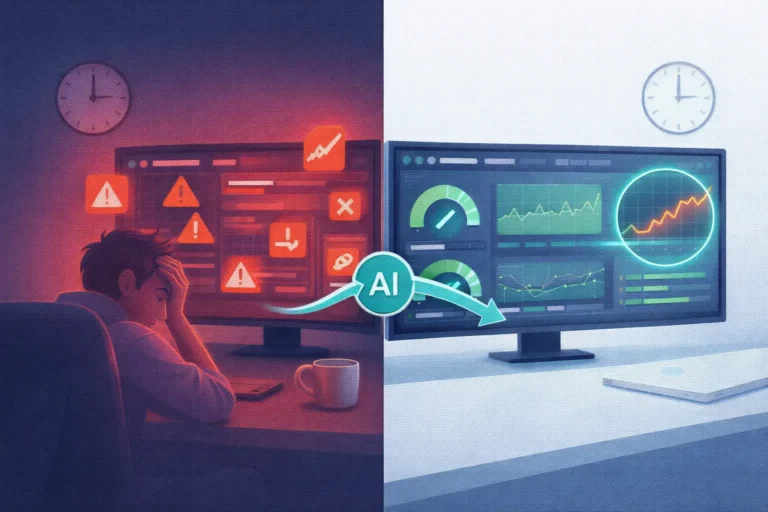
Software maintenance is where budgets quietly go to die. Indeed, our recent benchmarks article showed upkeep consumes 50 to 80 percent of total ownership cost over a system’s lifetime. Naturally, that share surprises teams until they actually measure their own spend. For most organizations, however, the question is not whether to care about maintenance costs. Instead, the real challenge is keeping it from eating the rest of the technology budget. Clearly, AI in software maintenance is the most substantial shift in that equation in a generation.
This is the fifth and final article in our series on AI across the software development lifecycle. So far, we have covered planning, development, testing, deployment, and DevOps. Finally, we close where most of the money actually goes: keeping systems running over the long haul.
Why Maintenance Is Finally AI-Ready
Maintenance is a pattern-rich domain. For instance, the same kinds of bugs recur across projects. Similarly, familiar dependencies become outdated. Predictable performance regressions also creep into systems. Notably, early warning signs appear before major incidents. For decades, however, these patterns were visible only to senior engineers who had seen enough systems to recognize them. AI in maintenance now promises to surface these patterns automatically. As a result, the senior engineer no longer needs to step in first.
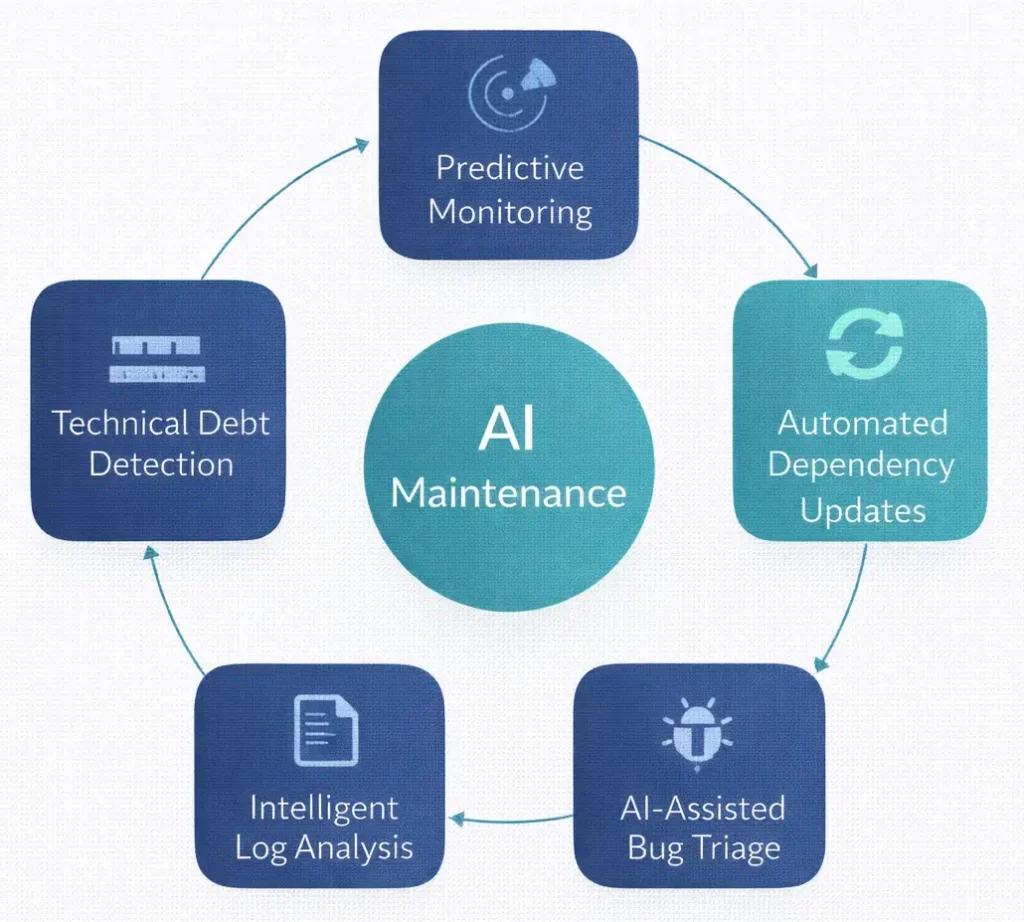
The honest frame: AI does not reduce the total amount of maintenance work that systems require. Instead, it shifts that work from reactive to preventive, and from expensive senior-engineer firefighting to inexpensive automated early detection. The economics change because preventive maintenance is four to five times cheaper than reactive maintenance. Consequently, running the same total budget but spending it earlier and more systematically produces better outcomes dramatically.
Predictive Monitoring: Catching Problems Early
First, the foundation of AI-assisted maintenance is predictive monitoring. Specifically, it continuously analyzes application and infrastructure metrics to flag systems that are trending toward trouble but are still functioning. For example, the database connection pools are gradually filling. Memory usage is climbing week over week. API response times are also creeping up. Finally, disk space running out six weeks from now at current growth.
None of these qualify as incidents yet. However, all of them will become incidents if teams ignore them. Traditional monitoring only catches them when they cross a threshold and trigger an alarm. By contrast, AI-assisted monitoring catches them when the trend becomes clear, often weeks before metrics cross any threshold. Importantly, that window is where the cost savings live. For instance, a planned capacity upgrade costs dramatically less than an emergency scale-out at 2 am.
Automated Dependency Updates: The Quiet Win
Out-of-date dependencies are the single largest source of preventable security vulnerabilities and one of the most reliably deferred maintenance tasks. Of course, teams know they should update. However, they rarely have time. As a result, they update in panicked batches when a critical CVE forces the issue. That is exactly when updates are most risky.
AI-assisted dependency management in 2026 does two things humans do poorly at scale. First, it continuously evaluates which dependencies the team can safely update based on the changes in each release. Second, it runs the full test suite against the proposed update. Then it surfaces only the passing updates as ready-to-merge pull requests. As a result, the team reviews and merges, rather than doing the research themselves. Consequently, codebases that used to accumulate months of dependency debt now stay current. In fact, a few minutes of review per week suffice.
AI-Assisted Bug Triage and Resolution
Every team has a backlog of bugs that nobody has time to investigate. Of course, some are genuinely urgent, some are trivial. However, many sit in the uncertain middle where nobody has the context to decide. AI-assisted triage reads each bug report and correlates it against the codebase, similar past bugs, and the team’s history. It then proposes a classification: severity, probable area of the code, estimated effort, and often a candidate fix.
Of course, the triage is not perfect. Specifically, about seventy percent of AI-proposed classifications match what a senior engineer would have chosen. The remaining thirty percent, however, need adjustment. Even so, any meaningful first-pass triage dramatically improves on the alternative: no triage at all. As a result, the engineering lead gets a sorted, annotated backlog instead of a wall of tickets. Importantly, that clarity supports better decisions about where to spend human attention.
Intelligent Log Analysis
In general, production logs are too voluminous for humans to read. Typically, engineers read logs only when they are already investigating a specific incident. As a result, they catch problems after the fact, not before. By contrast, AI-assisted log analysis runs continuously in the background, looking for patterns that deviate from normal. For example, new error types, changes in error frequency, unusual user behavior, and emerging bot traffic.
Notably, the surfacing stays conservative in 2026. Specifically, the system flags only deviations that are statistically unusual enough to warrant attention. As a result, engineering teams receive a weekly summary of the few issues worth looking at. They no longer face a continuous firehose of noise. Clearly, this represents exactly the kind of task humans do poorly. In short, we get tired and ignore the boring parts, while machines stay focused.
Technical Debt Detection
Finally, the fifth capability is the newest and most interesting. Specifically, AI-assisted technical debt analysis reads the codebase and flags files, modules, and patterns that cost disproportionately more to maintain. For example, files that three different engineers touch every week. Likewise, functions that have grown past the size where humans can reliably reason about them. Also, modules that lack tests and have seen multiple bug fixes in the last quarter.
The output is a prioritized technical debt map. Consequently, teams can use it to target refactoring efforts where it will actually reduce maintenance costs. Previously, this was work that relied entirely on a senior engineer’s intuition. That intuition was often correct. However, formalizing it into a plan was slow enough that most teams skipped it. Our earlier guide on managing technical debt covers the broader playbook. In particular, AI-assisted detection is the piece that has changed the most in the last year.
The Shift in Maintenance Economics
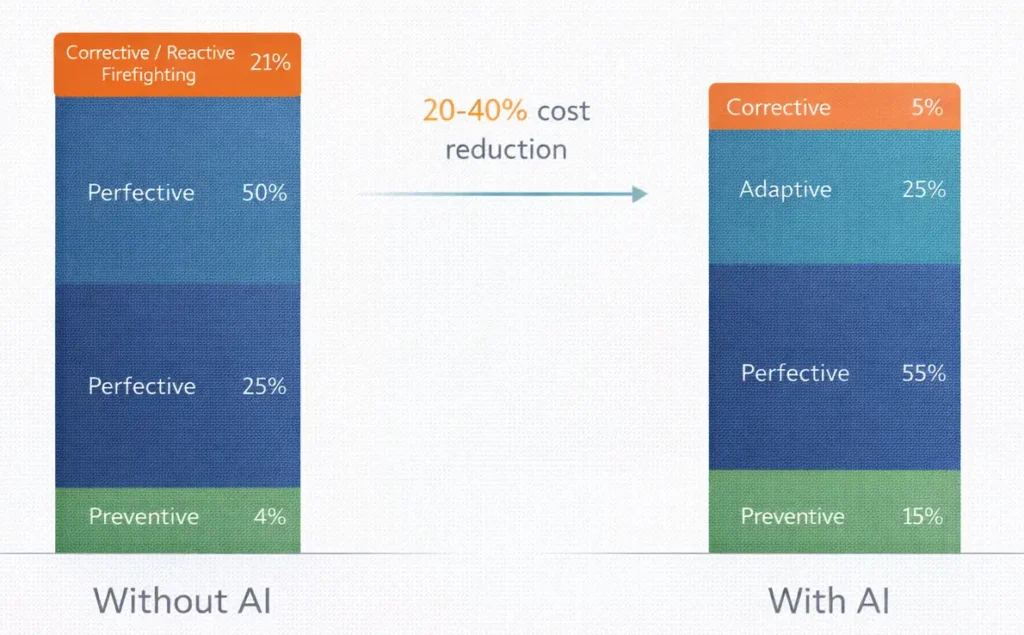
Overall, the cumulative effect of these five capabilities is a measurable shift in the distribution of maintenance costs. In fact, teams that adopt AI-assisted maintenance well typically cut total spend by 20 to 40 percent within two quarters. Importantly, the savings do not come from doing less maintenance. Instead, they come from doing it earlier, more systematically, and at a lower per-task cost.
Furthermore, the mix also shifts. In the pre-AI baseline, for example, roughly 21 percent of maintenance effort goes to corrective work (bug fixes in production). Meanwhile, only 4 percent goes to preventive work (hardening before problems occur). By contrast, in teams using AI-assisted maintenance well, corrective work drops to around 5 percent. Meanwhile, preventive work climbs to 15 percent. Indeed, that is the single largest change in the maintenance mix since the widespread adoption of continuous integration.
Where AI-Assisted Maintenance Still Falls Short
Of course, the honest caveats apply here as in every other part of this series. Specifically, AI is poor at diagnosing genuinely novel failure modes. For instance, suppose your system encounters a wholly novel problem. The AI will pattern-match it against something superficially similar. It will then confidently propose a wrong diagnosis. Therefore, human engineers still need to own the novel cases.
Similarly, automated dependency updates can introduce subtle regressions when the test suite is not thorough. Likewise, bug triage only matches the ticket quality — a vague user report still requires human interpretation. Furthermore, technical debt detection surfaces correlations rather than causes. For instance, some of the files that look expensive cost more because of organizational history. Clearly, no amount of refactoring will fix that.
In each case, the mitigation is the same pattern we have seen across the series. Specifically, AI accelerates pattern-rich work, while humans make the judgment calls. As a result, teams that preserve this division get the productivity gain without the horror stories.
How Pegotec Approaches AI in Maintenance
We offer AI-assisted maintenance as a core part of our AI-Enhanced Software Maintenance service. Specifically, predictive monitoring runs across every production system we support. In addition, our team handles dependency updates as routine background work rather than emergency projects. Meanwhile, bug triage uses AI as a first-pass assistant with human engineering leads making the final priority calls. Log analysis also runs continuously and surfaces weekly summaries. Finally, technical debt analysis runs quarterly and informs the refactoring roadmap.
For clients running their own maintenance, we help set up these capabilities and coach teams through the adoption period. Of course, like every other AI adoption, this has a learning curve. Naturally, it requires patience and discipline to navigate. However, the return on that investment proves substantial and durable. Specifically, you get lower ongoing costs and fewer user-visible incidents. Teams also free up engineering time for work that advances the business.
In conclusion, this article closes our five-part series on AI across the software development lifecycle. Want help applying these patterns to your own systems — planning, development, testing, DevOps, or maintenance? Then contact Pegotec for a no-obligation consultation. Furthermore, we encourage you to read the full series from article one forward for the complete picture.
Conclusion
Overall, AI in software maintenance in 2026 is the most economically significant AI shift across the software development lifecycle. Planning and development get the attention. Maintenance, however, is where the money actually is. Specifically, five capabilities drive the change: predictive monitoring, automated dependency updates, AI-assisted bug triage, log analysis, and technical debt detection. Together, they shift teams from reactive firefighting to predictive care.
Importantly, the gain represents more than a one-time efficiency. Instead, it marks a durable shift in the cost curve of software ownership. For example, systems that once consumed 70 percent of the engineering budget in maintenance now consume 50 percent. Moreover, they deliver better uptime. In short, that captures the practical promise of AI in 2026, across every stage of the lifecycle. Above all, the point centers not on replacing human judgment but on amplifying it. Finally, when teams execute this at scale, good engineering practice becomes economic.
Frequently Asked Questions
In fact, teams that adopt AI-assisted maintenance well typically cut total spend by 20 to 40 percent within two quarters. Specifically, the gain comes from shifting work from reactive firefighting to preventive care, not from doing less maintenance overall. However, teams that try to cut the maintenance budget outright rarely achieve sustainable savings. In short, the savings come from doing maintenance better, not from avoiding it.
Only when a thorough test suite catches the regressions that an update might introduce. Specifically, the working pattern for 2026 is as follows: AI-proposed updates pass the full test suite first. Then they reach a human reviewer as ready-to-merge pull requests. However, fully autonomous dependency merging carries risk unless test coverage stays very high. In addition, the consequences of a regression must stay small. Therefore, start with automated proposals and human review, then expand autonomy slowly as the team builds trust.
No. Specifically, AI in 2026 shifts the time maintenance engineers spend on, not whether teams need them. For example, AI helps most with pattern-rich work: monitoring metrics, evaluating dependency releases, triaging bug reports, and reading logs. However, the judgment calls, novel problem diagnosis, and relationship work with stakeholders remain firmly human. As a result, maintenance team headcount typically stays stable. In short, the mix of work simply shifts toward higher-leverage activities.
First, start with automated dependency updates. Specifically, they deliver immediate, visible value: a codebase that stays current without emergency efforts. Notably, the failure modes are easy to spot, since any problem shows up as a failed test. They also teach the team to trust AI-proposed changes in a low-stakes context. Next, predictive monitoring usually requires integrating with your existing observability stack. Finally, AI-assisted bug triage, log analysis, and technical debt detection come later. As a result, the team can adopt them once it has built confidence with the foundational capabilities.
Indeed, software maintenance accounts for 50 to 80 percent of the total software ownership cost over a system’s lifetime. However, AI does not dramatically reduce that percentage. For example, in well-maintained systems, the share drops from 70 to 80 percent, falling into the lower-middle band. Specifically, that band runs roughly 50 to 60 percent. More importantly, the absolute dollar amount at that lower percentage falls by 20 to 40 percent compared to running without AI. Finally, see our earlier benchmarks article for the full breakdown by industry and software type.
Let's Talk About Your Project
Enjoyed reading about AI in Software Maintenance: From Reactive Firefighting to Predictive Care? Book a free 30-minute call with our consultants to discuss your project. No obligation.